Educational videos can help Shopify store owners gain customer trust and boost sales. They address the "trust gap" in online shopping by visually demonstrating products, sharing behind-the-scenes content, and featuring testimonials. Here’s the importance of video content in e-commerce:
- Clarity: 96% of marketers say videos make products easier to understand, and viewers retain 95% of information from videos compared to 10% from text.
- Trust: 66% of shoppers trust brands that are transparent, and 73% prefer short videos for learning about products.
- Sales Impact: 87% of marketers report increased sales from video marketing, and 88% of viewers are convinced to purchase after watching a video.
### Top Video Marketing Strategies for Building Trust:
- Tutorials: Show how to use products and solve problems.
- Brand Stories: Humanize your business by sharing values and processes.
- Customer Testimonials: Showcase real experiences to validate your product.
Where to Place Videos:
- Product Pages: Tutorials and demos to clarify features.
- Homepage/About Us: Brand stories to connect with visitors.
- Landing Pages: Explainers to address objections.
By embedding videos strategically and tracking performance metrics like conversions and engagement, you can strengthen customer confidence and drive repeat purchases. Start with one or two videos addressing common questions, and expand your library based on audience feedback.
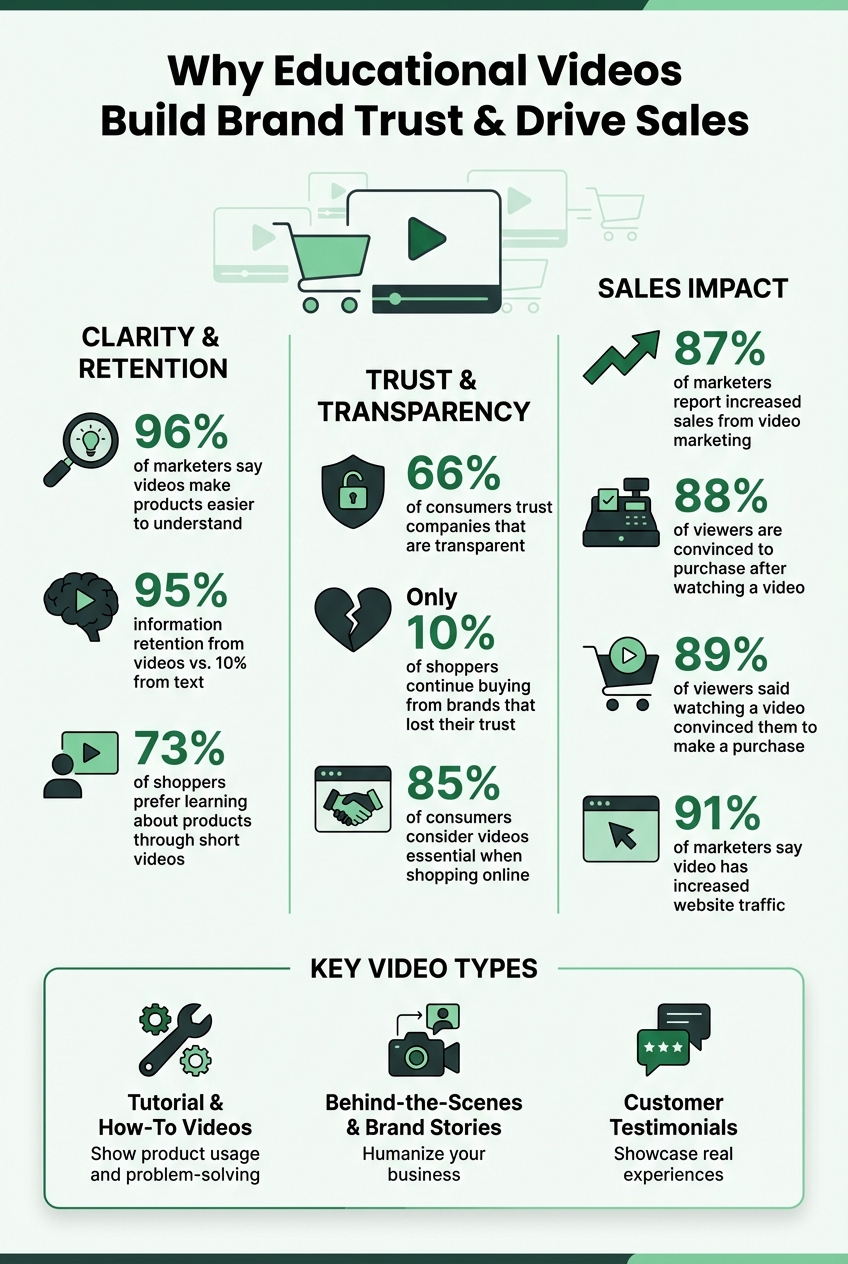
Educational Video Marketing Statistics: Trust, Engagement, and Sales Impact for E-commerce
Educational Marketing in 2026: How to Build Trust & Attract Clients
sbb-itb-d9e5b3a
The Trust Problem in Online Shopping
Online shopping comes with a built-in challenge: customers can't physically inspect what they're buying. This limitation creates hesitation. Shoppers worry about wasting money, doubt whether a product will work as promised, and feel uncertain about fit or quality. In a physical store, you can touch, test, and ask questions. Online, it feels distant and impersonal. Add hidden costs at checkout, unclear return policies, or generic website designs, and trust erodes even further - making many shoppers abandon their carts.
It doesn’t take much to break trust online. Poorly designed websites, low-resolution product photos, and sloppy, error-filled descriptions immediately make buyers question a store’s legitimacy. Video strategist Brad Powell describes this as a “foggy sea” of options, where too much confusion kills confidence and delays purchases entirely. These trust gaps directly affect sales, as research increasingly shows.
Why Trust Drives Sales for Shopify Stores

Trust isn’t just important - it’s the key factor that drives sales. Justin Shriber, VP of Marketing at LinkedIn Sales and Marketing Solutions, emphasizes that trust is the #1 factor in closing a deal, even more than price or return on investment. For Shopify stores, this means customers don’t necessarily choose the brand with the best features or lowest prices - they choose the one they trust most.
The statistics back this up. 66% of consumers say they trust companies that are upfront about how they use personal data. But once trust is broken, it’s nearly impossible to recover - only 10% of shoppers will continue buying from a brand that’s lost their confidence. This explains why trust directly impacts conversion rates, repeat purchases, and customer loyalty. When shoppers feel uncertain, they hesitate or abandon their carts. When they feel confident, they buy - and they come back.
How Educational Videos Solve Trust Issues
One of the most effective ways to bridge the trust gap is through educational videos. These videos give customers a clear, visual understanding of your product or service, removing the guesswork. Instead of asking shoppers to imagine how something works, videos show them directly.
A great example comes from The Narrow Lane, a high-end landscape design company. In August 2025, they released a transparency video featuring Operations Manager Scott Koenig. The video broke down costs, phased installations, and accurate estimates, addressing common concerns about pricing. As a result, homeowners reached out with greater confidence, knowing exactly what to expect before committing.
This approach works because videos simplify complex ideas, build credibility, and give customers the clarity they need to feel secure in their decisions. Research shows that 73% of shoppers prefer learning about products through short videos instead of reading text, and 85% of consumers consider videos essential when shopping online. Videos help in three key ways: they humanize your business by showing the people behind it, they demystify your processes by explaining how things work, and they prove your expertise through clear demonstrations.
Brad Powell sums it up well:
"While confusion will kill confidence, clarity will help you sell" - Brad Powell
Types of Educational Videos That Build Customer Trust
Different types of educational videos can address specific customer concerns at various stages of the buying process. Choosing the right format ensures customers feel confident about their purchase. These video styles tackle common trust barriers head-on.
Tutorial and How-To Videos
Tutorial videos position your brand as a helpful guide rather than pushing a hard sell. They show customers how to use a product, solve a problem, or complete a task, easing any doubts they might have.
According to data from 2025, 73% of video marketers created explainer videos, and 89% of viewers said watching a video convinced them to make a purchase. On top of that, 88% of businesses made buying decisions after watching a video. Since people retain much more information from videos compared to text, these tutorials can make a lasting impression.
If you run a Shopify store, adding tutorial videos can be simple. Tools like UWidget let you embed YouTube videos directly onto your product pages, homepage, or anywhere else customers might need extra clarity. Once you've covered tutorials, you can deepen trust by sharing your brand's personal story.
Behind-the-Scenes and Brand Story Videos
Behind-the-scenes videos give customers a glimpse into your brand’s journey, values, and creative process. For online stores without a physical presence, these videos help humanize your business by putting faces to your name instead of just showing a logo.
Charlotte Palermino, Cofounder and CEO of Dieux Skin, highlights the power of this approach:
"We call ourselves a 'too much information' brand. Sharing that journey - sharing what your skin needs, what it doesn't, how it's so varied... really actually resonated with people because it's real."
This kind of transparency taps into the Mere Exposure Effect, where repeated exposure makes people feel more comfortable. Research shows 66% of consumers trust transparent companies, and 95% of marketers report improved brand awareness from video content. By sharing your story, you create emotional connections that naturally lead to trust and social proof.
Customer Testimonial and User Experience Videos
Customer testimonials are one of the most effective ways to build trust. These videos let real customers share their honest, unscripted experiences, answering the question every shopper silently asks: "Will this work for me?" Seeing relatable people explain how a product solved their problem can be incredibly reassuring.
For Shopify store owners, tools like ILikeThat can enhance social proof by collecting and displaying customer interaction through product like buttons. Pairing these features with testimonial videos adds an extra layer of credibility to your brand.
How to Use Educational Videos Effectively on Shopify
Placing educational videos strategically on your Shopify store can help build trust with your audience and boost sales.
Where to Place Videos on Your Store
Product pages are a great spot for demos, unboxing videos, or technical guides. These types of videos help customers see your product in action. Considering that 96% of consumers have watched explainer videos to learn more about a product or service, having tutorials here can ease doubts and encourage purchases at the decision-making moment.
Your homepage and "About Us" pages are perfect for sharing your brand story or behind-the-scenes content. These videos establish a personal connection with first-time visitors. On the other hand, blog posts benefit from embedded educational videos, which not only position you as an expert but also improve SEO by increasing time spent on your site. Landing pages can feature campaign-specific videos or explainers to guide hesitant buyers through your sales funnel. Sending links to assembly or how-to videos in confirmation emails also ensures a smooth post-purchase experience and reduces support requests.
| Video Type | Best Placement | Strategic Purpose |
|---|---|---|
| Brand Story / BTS | Homepage, About Us | Build a connection with new visitors |
| Tutorial / How-To | Product Pages, Blog | Address doubts with clear demonstrations |
| Testimonial | Product Pages, Homepage | Reinforce trust through peer validation |
| Unboxing | Product Pages, Social Media | Set realistic expectations for new buyers |
| Explainer | Landing Pages, Product Pages | Overcome objections before checkout |
Each placement ensures your videos provide clarity exactly when customers need it most. To simplify integration, Shopify apps can help add videos even if your theme lacks built-in support.
Using Shopify Apps for Video Integration
If your Shopify theme doesn’t support video galleries, apps can fill the gap without requiring coding skills. For example, UWidget allows you to embed YouTube videos on product pages, homepages, or blogs. You can display videos through galleries, carousels, sliders, or even sticky formats that stay visible as users scroll. Embedding YouTube videos also improves SEO, as Google prioritizes sites with this type of content.
For stores with multiple product variants, Varco helps by pairing specific educational videos with individual variants on collection pages.
By making videos accessible throughout the shopping experience, you can replace uncertainty with confidence - a key driver of trust. Once integrated, it’s important to measure how these videos are performing.
Tracking Video Performance and Results
To determine whether your videos are effective, track metrics like conversions, sales, and engagement. Conversion rates and sales figures provide a clear picture - 87% of marketers report that video marketing has directly helped them increase sales. Compare conversion rates between customers who watch your videos and those who don’t to assess their impact.
Engagement metrics such as watch time, shares, and comments reveal whether your content is holding attention. If viewers drop off before reaching your call-to-action, consider shortening the video or refining its focus to better address customer concerns. Additionally, customer feedback and testimonials can indicate whether your videos are resonating.
Tutorial videos can also reduce the volume of support inquiries. For example, Luxy Hair co-founder Mimi Ikonn observed that educational content decreases "support debt", or the number of recurring customer service questions. Tools like CheckIt can help you monitor checkout completion rates, showing whether videos on landing pages effectively guide customers through the final stages of their purchase.
Finally, keep an eye on SEO performance by tracking rankings for product pages with embedded videos. Since 91% of marketers say video has increased website traffic, improved rankings can bring more potential customers to your store.
Conclusion
Educational videos do more than just inform - they build trust and can directly impact your sales. When customers can clearly understand your products through tutorials, connect with your brand through behind-the-scenes content, or relate to real-life testimonials, they’re far more likely to make a purchase. In fact, research shows that 88% of businesses have seen customers decide to buy after watching a video, and 87% of marketers say video marketing has led to increased sales.
For Shopify stores, this is even more important since trust plays a huge role in purchasing decisions. Once that trust is broken, only 10% of shoppers will stick with the brand.
Incorporating videos doesn’t have to be complicated. Use tools like UWidget to integrating YouTube with your Shopify store and brand stories, Varco to pair videos with product variants, or ILikeThat to boost engagement. These tools make it easier to add videos that enhance credibility and build customer confidence.
To get started, focus on creating compelling video content that address common customer questions or concerns. Place these videos on your homepage or product pages, and track how they perform using metrics like conversion rates and engagement. Over time, refine your strategy to focus on what resonates most with your audience. Remember, consistency is key - a regular schedule of helpful content builds loyalty far better than sporadic efforts. With 96% of marketers reporting that videos have improved user understanding of their products or services, this is a smart investment that can strengthen trust and boost revenue.
FAQs
What should my first educational video cover?
Your first educational video should tackle the questions or concerns your audience frequently has about your products or services. Why? Because addressing these right away helps you connect with viewers and shows you’re there to help - not just sell.
Focus on clear, helpful answers. For instance:
- Walk viewers through how your product works, step by step.
- Highlight benefits that solve their specific problems.
- Share insider tips or advice related to your industry.
By doing this, you’re not just explaining products - you’re positioning your brand as a go-to expert. That kind of trust is invaluable when you’re just starting to build relationships with your audience.
How long should product education videos be?
Product education videos work best when they’re six minutes or less. Why? Studies reveal that viewer engagement takes a nosedive with longer videos. On the flip side, shorter videos are more likely to hold attention, leading to higher retention and completion rates. Keeping things brief ensures your audience stays focused and takes in the key information.
How do I tell if my videos are increasing trust?
To gauge whether your videos are building trust, focus on viewer engagement metrics such as comments, shares, and likes. Pay attention to shifts in customer behavior, like an increase in inquiries, conversions, or repeat business. Incorporate trust signals - such as testimonials or endorsements from experts - and evaluate their influence through feedback or surveys. By combining engagement data, audience input, and trust signals, you can determine how well your videos are fostering trust.