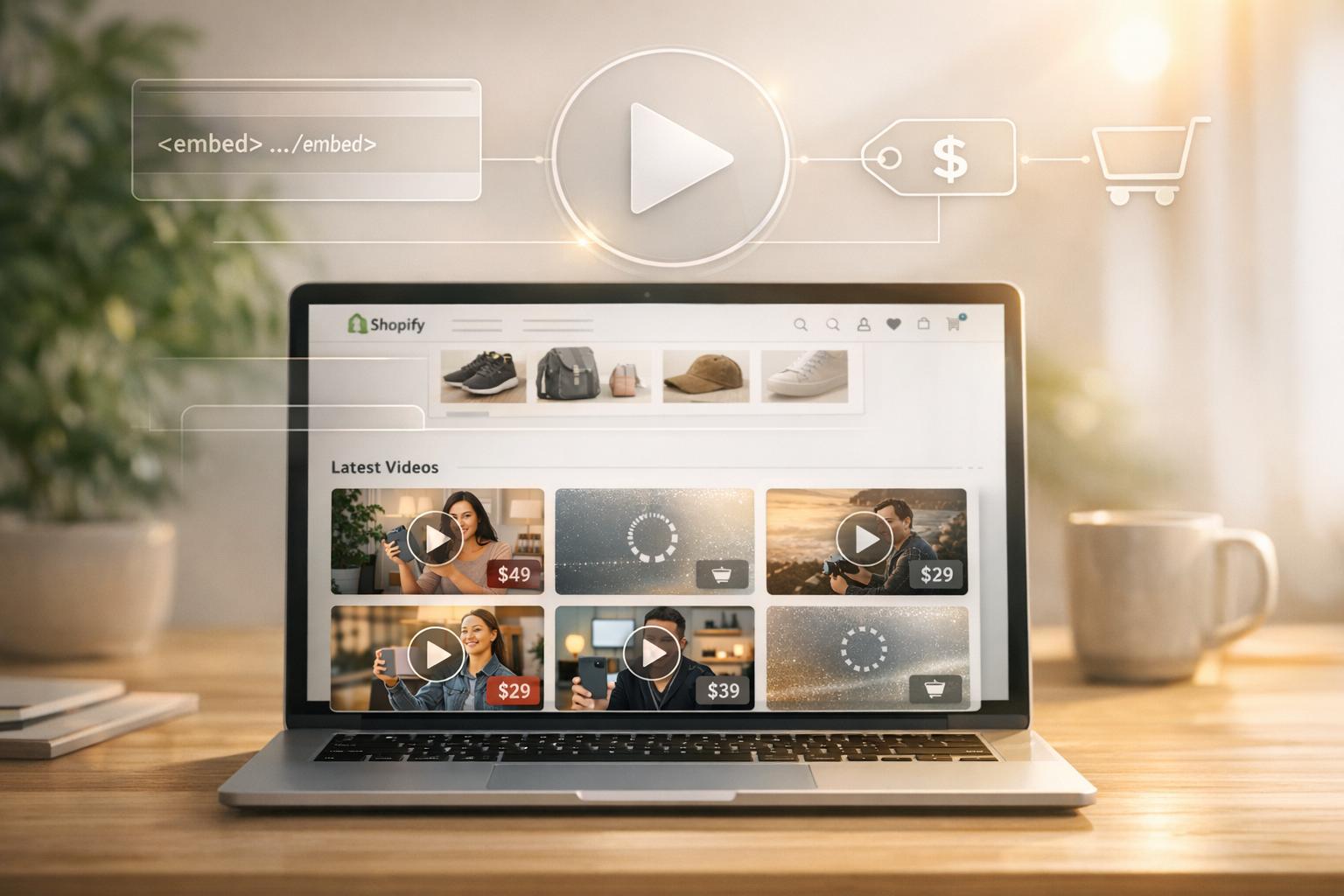
Video content has become a critical tool in e-commerce, driving engagement, trust, and sales. Here's why it works:
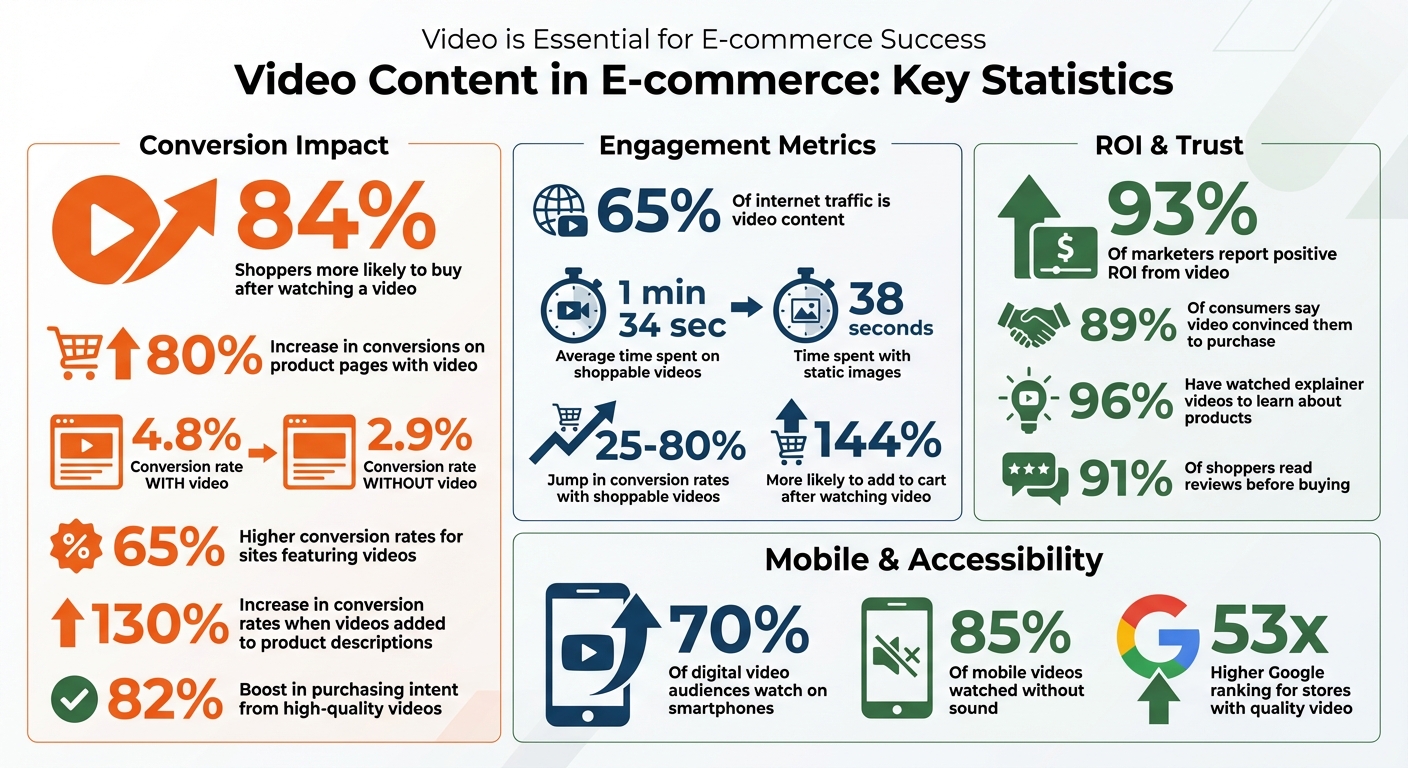
- Boosts Conversions: Shoppers are 84% more likely to buy after watching a video. Product pages with video see an 80% increase in conversions.
- Builds Trust: Videos demonstrate products in action, reducing doubts and answering questions upfront.
- Dominates Online Traffic: Video accounts for 65% of internet traffic, with platforms like TikTok and YouTube fueling sales.
- Increases Engagement: Websites featuring videos see 65% higher conversion rates compared to those without.
- Shoppable Features: Interactive videos make purchasing seamless, with conversion rates jumping by up to 80%.
Video is no longer optional for e-commerce success. It bridges the gap between online browsing and confident purchasing decisions, making it a must-have for any online store.
Video Content Impact on E-commerce Conversions and Engagement Statistics
10 killer examples of ecommerce product videos that drive conversion
sbb-itb-d9e5b3a
How Video Increases Engagement and Conversions
Video content doesn’t just grab attention - it reshapes how customers interact with your Shopify store. Websites that feature video see a conversion rate of 4.8%, compared to only 2.9% for those without - a 65% boost. This shift is driven by the power of visual storytelling, interactive shopping experiences, and clear product demonstrations.
Visual Storytelling: Building Emotional Connections
Video lets you go beyond listing product features to tell stories that resonate with your audience. When customers see products in relatable settings - like jewelry at a wedding or furniture in a cozy living room - they can picture their own experiences, creating a connection that static images simply can’t match.
Here’s the science: humans process visuals 60,000 times faster than text. Combine that with the emotional weight of a good story, and you’ve got a recipe for stronger customer engagement. Personalized video content, in particular, is 3.5 times more likely to lead to a purchase.
Simon Byrne, Head of Digital Marketing at Bazaarvoice, puts it perfectly:
"Stories are what connects us. They're the difference between someone buying a product versus an experience, something purely material versus a narrative they can relate to on a personal level."
To make the most of visual storytelling, use models and settings that reflect your audience’s lifestyle. Show transformation stories - like before-and-after skincare results or outfit changes - to illustrate real value. Keep your hook strong; you’ve got only the first three seconds to grab attention. And since 85% of mobile videos are played without sound, your visuals and captions need to do the heavy lifting.
Shoppable Videos: Making Buying Effortless
Traditional e-commerce has friction. After watching a video, customers often have to leave the page, hunt for the product, and go through several steps to make a purchase. Shoppable videos solve this problem by embedding clickable links and "Add to Cart" buttons directly into the video [1,11].
The results speak for themselves. On average, viewers spend 1 minute and 34 seconds on shoppable videos, compared to just 38 seconds with static images. Conversion rates jump by 25%–80%, with 7% of viewers engaging with shoppable widgets and 75% watching the videos to the end.
Take Dr. Dennis Gross, for instance. They achieved an 8.2% conversion rate with shoppable videos, generating over $1 million in revenue and a 328x ROI. LABFRESH saw a staggering 16.7% conversion rate, far above Shopify’s 1.4% average. Ralph Lauren’s global shoppable video series, featuring Netflix's "Elite" cast, achieved a 7.86% click-through rate and a 33.94% interactive view rate.
For Shopify users, tools like UWidget make it easy to embed interactive YouTube videos directly on product pages. This approach fits perfectly with the swipe-up and vertical video habits of Gen Z and Millennials [1,11].
Jeremy Michael Cohen, Co-founder of Tortuga Backpacks, shares his experience:
"Videowise is a no-brainer for us. Unlike many tools we've tested, it's cost-effective and paid for itself from the time we installed it."
While shoppable videos streamline purchasing, product demonstrations take it a step further by building trust and clarifying details.
Product Demonstration Videos: Building Confidence in Purchases
Demonstration videos fill the gap left by the inability to touch or try products online. By showing items in action - highlighting multiple angles and real-life uses - they help customers feel confident about what they’re buying [4,16].
The numbers are clear: 89% of consumers say watching a brand’s video convinced them to make a purchase [14,4], and 96% have watched explainer videos to learn about a product. These videos also reduce returns by setting accurate expectations. Whether it’s showing how a jacket fits different body types, how a couch looks in a living room, or how a gadget works, customers make better decisions, leading to higher satisfaction [5,4].
For best results, keep product demos short - 30 to 60 seconds for quick highlights, or up to 10 minutes for in-depth tutorials [14,16]. Optimize for mobile by using vertical or square formats [7,16], and always add captions since most mobile videos are watched without sound [7,16]. Place these videos strategically on product pages, landing pages, and even in email campaigns to maximize their impact [14,5].
Authenticity is key. Raw, relatable content featuring employees or real customers often outperforms polished studio productions. User-generated content (UGC), like video reviews, builds trust in ways traditional ads can’t. With 91% of shoppers reading reviews before buying, video reviews capture emotions and details that written testimonials simply don’t [5,16].
Best Practices for Using Video Content on Shopify

Video content has proven to be a game-changer for boosting conversions. But when it comes to your Shopify store, how you use video can make all the difference. From strategic placement to smart tools and SEO tactics, here’s how to make your videos work harder for your business.
Where to Place Videos on Product Pages
Your product pages are the heart of your store, and where you place videos can directly influence whether a customer clicks "Add to Cart." The best spot? Right within your product listings and descriptions. This is where shoppers naturally look when deciding on a purchase, so having a video here can answer questions, showcase your product from every angle, and eliminate doubts right away.
With most shoppers using mobile devices, your videos must be mobile-friendly. That means creating vertical videos with a 9:16 aspect ratio - the standard for mobile viewing. And don’t forget: 85% of mobile videos are watched without sound. To keep your message clear, include subtitles, visual titles, and captions so your videos still deliver value even when muted.
The impact of videos speaks for itself. Adding high-quality videos to product descriptions can boost purchasing intent by 82% and increase conversion rates by 130%. Plus, stores with at least one well-made video can rank up to 53 times higher on Google than those without.
Using UWidget for Video Marketing

Once your video placement is optimized, take it a step further with tools that make your videos interactive. Shopify doesn’t offer built-in shoppable video features, but third-party apps like UWidget can fill the gap. UWidget allows you to embed YouTube videos into your store and create galleries, carousels, sliders, and more.
One standout feature is the ability to sync your product catalog with video widgets. This means you can create shoppable galleries and sliders, allowing customers to buy directly from the video. Add "Add to Cart" buttons, lead capture forms, or even discount codes to make the shopping experience seamless.
To ensure your site stays fast, UWidget uses lazy loading, which only processes videos when they come into view on the screen. This prevents videos from slowing down your page load times - critical for keeping customers engaged. The app also supports optimized titles, tags, and descriptions to improve your videos' visibility.
SEO for Video Content: Making Your Videos Discoverable
Even the best videos won’t help if no one sees them. That’s where video SEO comes in. Start by optimizing your video titles, descriptions, tags, and hashtags with relevant keywords. This helps both search engines and potential customers find your content when searching for products like yours.
Hosting your videos on YouTube is a smart move. Not only is YouTube the second-largest search engine globally, but Google often prioritizes YouTube-hosted videos in search results. Embedding these videos on your Shopify store gives you double the exposure. Be sure to add links to your product pages in the video descriptions to drive traffic back to your store.
Another key tactic is using structured data (schema markup) to help search engines recognize and index your videos. This can increase the chances of your videos appearing in rich snippets on search results pages. As Shopify staff explains:
"Using structured data (schema markup) for videos helps search engines recognize and index your content more effectively. This can potentially earn your content a place in rich snippets on SERPs."
Don’t overlook accessibility features like captions, transcripts, and audio descriptions. These not only make your content more inclusive but also help search engines index the spoken content within your videos. With 78% of video marketers already using these features, it’s clear they’re essential for visibility.
Lastly, make sure your video is the main focus on the page. If it’s buried or secondary, search engines might not display it as a thumbnail in search results. Create videos that answer common customer questions or use keywords like "best [product]" or "[brand] vs [brand]" to tap into specific search intent.
Measuring Video Content Performance
Tracking how your video content performs can tell you a lot: what’s driving sales, where viewers lose interest, and how to fine-tune your approach. Understanding these metrics helps you create videos that not only engage but also convert. Let’s dive into the key metrics, analytics tips, and testing strategies that can keep your video strategy on point.
Key Video Metrics to Track
Not all metrics are equally important, especially when it comes to your Shopify store. Focus on the ones that directly impact your sales. Metrics like watch time and retention percentage are great indicators of viewer engagement. For example, if you notice a sharp drop-off early in the video, it may mean your opening isn’t grabbing attention.
Metrics like click-through rate (CTR) and add-to-cart actions are critical for measuring how many viewers are moving closer to making a purchase. These numbers help separate videos that entertain from those that actually drive revenue. In fact, 93% of marketers say video content delivers a positive return on investment.
If you’re using shoppable videos, track interactive tag clicks to see which products catch viewers’ attention. If certain items consistently get clicks while others don’t, that’s a clear signal to adjust your strategy. Interestingly, 28% of video marketers analyze engagement graphs and heat maps to identify key moments where viewers take action - or drop off.
| Metric Category | Data Points | Impact on Shopify Store |
|---|---|---|
| Engagement | Watch time, retention percentage, heat maps | Highlights content quality and drop-off points |
| Conversion | Click-through rate (CTR), add-to-cart actions, ROI | Measures sales impact and revenue |
| Visibility | Search rankings, social shares, traffic sources | Assesses SEO and brand reach |
| Interactivity | Poll responses, clickable tag interactions | Tracks customer interest and participation |
Using Analytics to Find Where Viewers Stop Watching
Basic metrics are helpful, but detailed analytics can show you exactly where viewers lose interest. Retention graphs, for instance, pinpoint the moments your audience tunes out. This can be a goldmine for improving your content. Since 85% of mobile videos are watched without sound, a sudden drop-off might mean your video relies too much on audio instead of visuals or captions.
Tools like UWidget can help you dig deeper. They let you track web traffic sources and embed locations, so you can see which product pages benefit the most from video content. If certain videos consistently underperform on specific pages, it might be time to rethink whether the content matches what shoppers need at that point in their journey.
A/B Testing Video Elements
Testing is a powerful way to figure out what works best for your audience. Try experimenting with video lengths - compare 15-second clips to 30-to-60-second versions to see what resonates. While 83% of marketers say videos under one minute are most effective, your audience might prefer more detailed product demos.
Thumbnails are another key element to test. They’re often the first thing viewers see, so play around with different images, text overlays, and styles to find what grabs attention.
You should also test CTA placement and wording. For example, does "Shop Now" perform better than "Learn More"? A clear and compelling CTA can make all the difference. 70% of sales teams report that sales-focused videos outperform other types of content for conversions, but only when the CTA is well-placed and effective.
Finally, test your messaging and tone. A polished, professional style might suit luxury products, while a more casual, authentic tone could resonate with younger shoppers. To save time, consider creating one longer video and editing it into shorter segments. This way, you can test different parts without starting from scratch.
Conclusion: Using Video to Grow Your E-commerce Business
Video content has become a game-changer for competitive Shopify stores. Shoppable videos, for instance, boast conversion rates as high as 20%, meaning one in five viewers takes the leap and makes a purchase. Combine that with the fact that 93% of marketers say video content delivers a strong return on investment, and it's easy to see why video is one of the most impactful tools for driving growth.
What makes video so effective is its ability to bridge the gap between browsing online and the tactile experience of in-store shopping. Product demonstrations, for example, give customers a clearer understanding of what they're buying, which can cut down on returns and reduce the need for customer support. In fact, after watching a video, shoppers are 144% more likely to add products to their cart. This combination of reducing friction and boosting confidence makes video a must-have tool for e-commerce success.
Getting started with video doesn’t take much. Affordable tools like UWidget make it simple to incorporate YouTube videos and Shorts into your store, offering features like shoppable galleries, carousels, and sticky videos - all starting at just $5.99/month. Whether you're highlighting product features, sharing customer testimonials, or creating how-to guides, the goal is to craft content that helps customers feel confident about their purchases. This seamless integration can lead to higher engagement and better conversion rates.
With 70% of digital video audiences watching on smartphones and younger generations expecting video-first shopping experiences, adapting your Shopify store to include video isn’t just about following trends. It’s about meeting your customers where they already are and giving them the tools they need to make informed decisions. Video isn’t optional anymore - it’s essential for staying competitive in the e-commerce world.
FAQs
How do shoppable videos help increase e-commerce sales?
Shoppable videos are changing the game for e-commerce, turning casual browsing into direct buying. With these videos, viewers can click on featured products right within the content, skipping the hassle of navigating through multiple pages. The result? A smooth, interactive shopping experience that keeps customers engaged longer and makes it easier for them to make a purchase.
Here’s the kicker: shoppable videos can boost conversion rates by as much as 80%. Some brands have seen an impressive 8.2% conversion rate, raking in over $1,000,000 in revenue. By showcasing products through dynamic, visual storytelling, these videos help customers grasp product details and benefits more effectively, building trust and encouraging purchases. By combining entertainment with the ease of instant buying, shoppable videos are turning casual viewers into loyal buyers, delivering tangible results for businesses.
What’s the best way to use videos on product pages to boost sales?
To get the most out of videos on product pages, position them prominently - ideally above the fold and near the main product image. This way, shoppers notice them right away without needing to scroll. Keep the videos brief and focused, highlighting just one feature or use case at a time. Make sure they load quickly on both desktop and mobile devices. Adding captions is a smart move so viewers can understand the message even with the sound off. And don’t forget to include clear calls-to-action like “Buy Now” or “Shop the Look” to guide shoppers toward making a purchase.
Want to take it a step further? Consider making your videos interactive. Tools like UWidget from Fractal Apps let you embed clickable product links, galleries, or carousels directly into the video. This turns your video into a dynamic shopping tool. Interactive videos not only grab attention but also encourage longer engagement, prompt scrolling, and provide a direct path to purchase - all of which can lead to higher conversion rates.
How can optimizing videos improve my e-commerce store's visibility?
When done right, optimizing your product videos for search engines - also known as Video SEO - can greatly improve your e-commerce store’s visibility. By incorporating relevant keywords into your video titles, descriptions, and tags, you align your content with the exact terms shoppers are searching for. This not only helps your videos rank higher in search results but also increases their chances of appearing in Google’s featured snippets or gaining traction on platforms like YouTube.
For the best results, focus on a few key areas. Make sure your videos load quickly (no one likes waiting), use eye-catching thumbnails, and give your video files keyword-rich names before uploading them. Embedding these videos directly on your product pages, paired with concise summaries, can improve both the video’s and the page’s search rankings. These small but effective tweaks can drive more organic traffic, keep visitors engaged longer, and even boost conversions - all without spending a dime on ads.
By treating your videos as powerful marketing tools and sticking to these best practices, you can turn them into an efficient and budget-friendly way to attract new customers to your store.