Want to keep readers engaged and boost conversions? Start by showing them how long it takes to read your blog posts. Adding a read time estimate helps visitors decide whether to read now or save for later, leading to up to 40% higher engagement rates. For e-commerce sites, where readers spend an average of just over 2 minutes per post, this small addition can make a big difference.
Key Points:
- Read time estimates are calculated based on average reading speeds (200–250 words per minute).
- They help set expectations, reduce bounce rates, and increase dwell time.
- Readers are more likely to finish articles when they see manageable read times, such as "3 min read."
- Shopify users can automate this feature with tools like Time2Read for $1.99/month.
Clear read time displays not only improve user satisfaction but also positively impact SEO and conversions. For e-commerce blogs, it’s a simple yet effective way to guide casual browsers into becoming engaged shoppers.
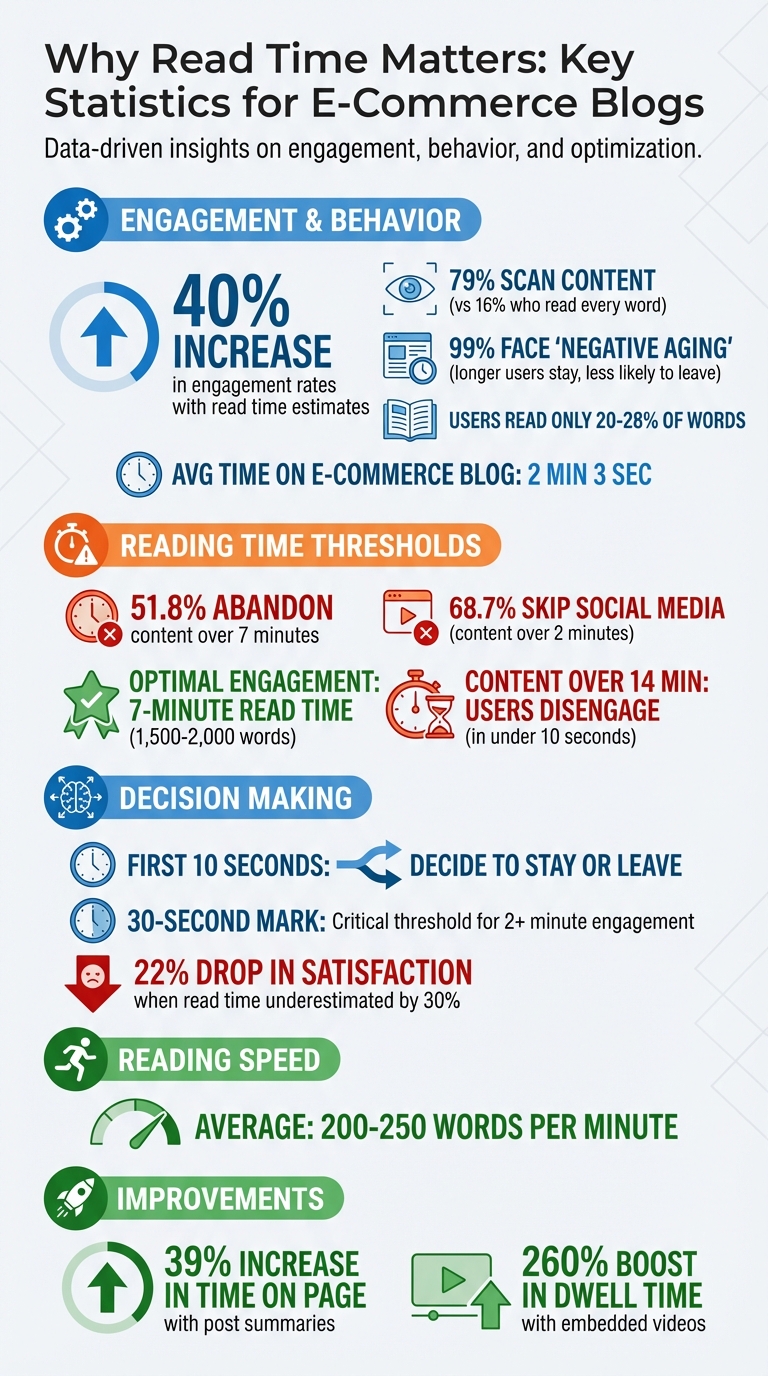
Read Time Impact on E-Commerce Blog Engagement Statistics
The Science Behind Read Time and User Engagement
Research Study Findings
When users arrive on a webpage, they form an impression almost instantly - within the first 10 seconds - deciding whether to stay or leave. According to Dr. Jakob Nielsen from Nielsen Norman Group, the key to holding their attention lies in immediately showcasing the value your content offers. A read time estimate plays a crucial role in this process.
"To gain several minutes of user attention, you must clearly communicate your value proposition within 10 seconds." – Jakob Nielsen, Ph.D., Nielsen Norman Group
This phenomenon is linked to cognitive anchoring, a psychological principle where read time estimates set expectations for the time commitment required. Dr. Eleanor Rigby, a Digital Cognitive Psychologist, explains that when the actual reading time aligns with the estimate, readers feel satisfied. On the flip side, if the content takes significantly longer than expected, dissatisfaction rises. For example, research revealed that underestimating read time by 30% led to a 22% drop in user satisfaction scores compared to accurate estimates.
Interestingly, 99% of web pages face "negative aging" - the longer users stay, the less likely they are to leave. If a read time indicator encourages someone to stick around beyond the critical 30-second mark, the chances of them staying for at least 2 minutes increase significantly. This underscores how read time estimates can shape engagement and align with broader patterns in user behavior.
User Preferences and Behavior
When exploring new pages, 79% of users scan the content, while only 16% read every word. Read time indicators are particularly helpful here, as they allow users to quickly gauge whether they should dive in or save the content for later. This is especially relevant since 51.8% of readers abandon content if the read time exceeds 7 minutes. On social media, the tolerance is even lower - 68.7% of users skip content longer than 2 minutes.
"Providing an estimated reading time shows respect for your reader's time." – Akshat Biyani, Contributing Editor, MarTech
Engagement tends to peak with a 7-minute read time, which corresponds to about 1,500 to 2,000 words. However, when content stretches to 14 minutes or more, most users disengage almost immediately, with average read times dropping below 10 seconds.
On average, users only read 20% to 28% of the words on a webpage. This selective behavior, known as "information foraging", involves skimming for specific details rather than consuming the entire text. Read time indicators help users evaluate whether the "cost" of their time is worth the potential value of the information, making them a practical tool for navigating content more effectively.
sbb-itb-d9e5b3a
How Read Time Affects Website Metrics
Bounce Rates and Dwell Time
Including a read time estimate on your blog posts can set clear expectations for visitors, helping them decide whether to engage right away or save the article for later. Research indicates that displaying estimated reading times can boost engagement rates by up to 40%. This simple feature allows readers to quickly judge whether they have enough time to read the content or need to revisit it later.
By managing expectations upfront, you can also reduce "pogo-sticking", where users leave your site quickly if the content seems longer than anticipated. For instance, if someone notices a blog post is a 3-minute read and they have a 5-minute break, they’re more likely to stay and finish the article. This leads to fewer immediate exits and longer session durations, which is great for your Shopify blog’s performance.
On average, users spend about 54 to 62 seconds on a web page across industries [22, 24]. For e-commerce sites, the average is slightly higher at around 2 minutes and 3 seconds. Features like post summaries can increase the average time spent on a page by 39%, while embedding videos can boost dwell time by as much as 260%.
Shopify store owners can use tools like Time2Read to automate the process of calculating and displaying read time estimates on blog articles. These enhancements not only improve engagement but also send positive signals to search engines.
SEO Benefits of Read Time Displays
While read time itself isn’t a direct ranking factor for Google, it plays a role in improving user experience signals that search engines care about [1, 25]. Google's RankBrain algorithm, for instance, tracks dwell time as a measure of user satisfaction. If your content aligns well with search intent and keeps visitors engaged, it’s more likely to perform better in search results [21, 25].
Read Time and E-Commerce Conversions
Conversion Case Studies
Adding read time displays to your content doesn’t just improve engagement - it can also drive conversions. When readers know upfront how much time they’ll need to invest, they’re more likely to complete the article and move further along the sales funnel. By setting clear expectations, these indicators help reduce hesitation, making it easier for potential customers to interact with content that leads them closer to making a purchase.
"The benefits of adding an estimated reading time to your blog post go beyond increased engagement and better ranking and have a positive impact on your sales funnel." – Michael Marchese, CEO of Tempesta Media
Read time labels also help minimize cognitive effort, making the decision to engage with content feel simpler. For instance, when a visitor sees a "3-minute read" tag, they can immediately decide whether to read it now or save it for later. This small but impactful feature helps reduce decision fatigue by removing uncertainty about the time commitment.
A real-world example comes from Aquarium Roots, a Shopify merchant. In January 2023, they introduced the Time2Read app to highlight estimated read times on their blog. Within a month, they saw not only a rise in readership but also an increase in customer inquiries about their products.
"In a short time, we have already seen not only a jump in readers, but also more calls with further questions." – Aquarium Roots
For store owners looking to replicate this success, automation tools like Time2Read can streamline the process and enhance conversions.
Using Time2Read for Shopify Blogs
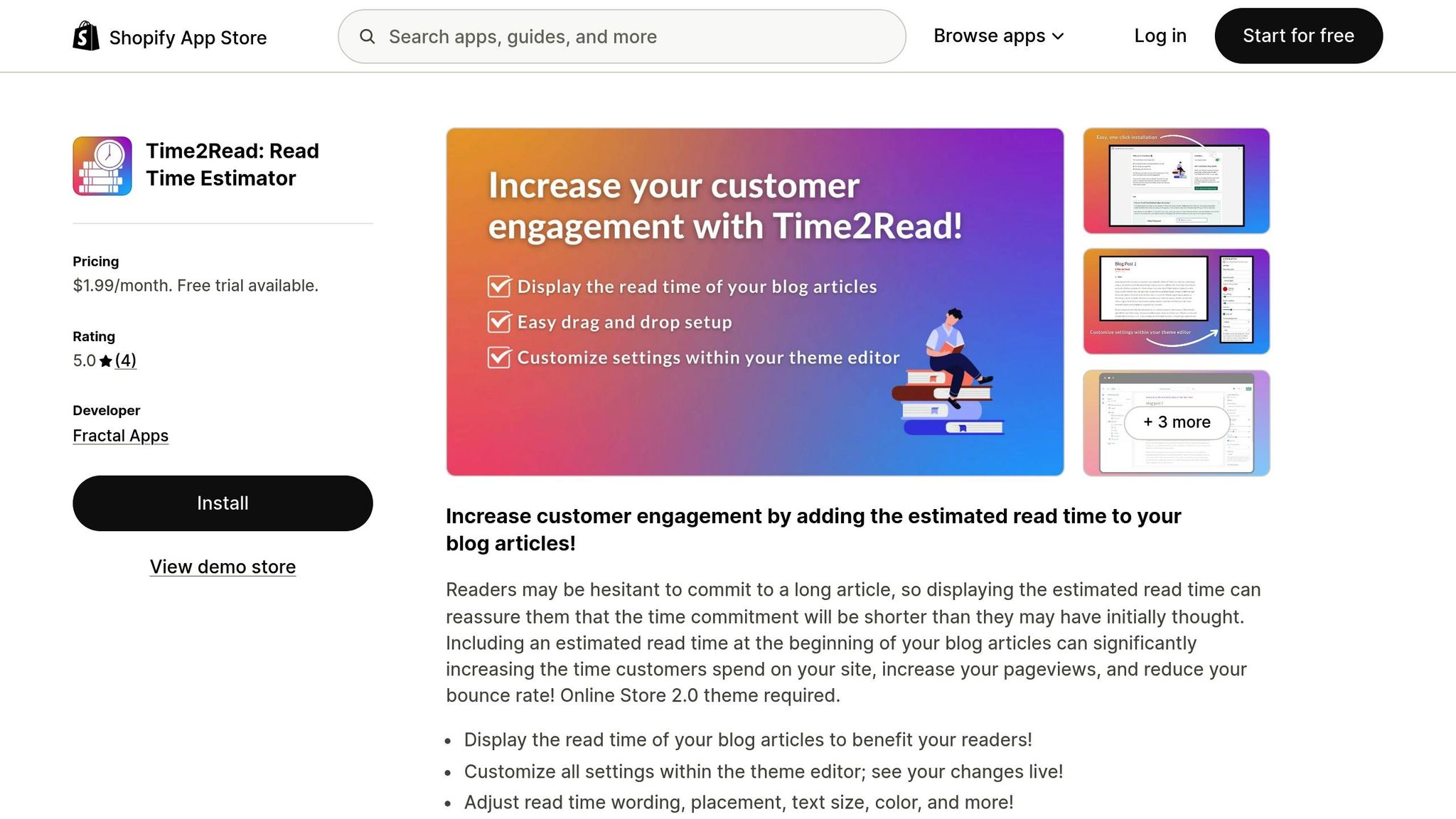
Manually calculating read times for blog posts isn’t practical for busy store owners, but automation makes it easy. For Shopify users, Time2Read handles this task seamlessly. The app determines read times based on an average reading speed of 200–250 words per minute and displays the estimate prominently on your blog posts.
Time2Read is designed for Shopify Online Store 2.0 themes and offers full customization options, including wording, placement, text size, and color - no coding required. With a perfect 5-star rating from merchants, the app is praised for its simplicity, clean interface, and excellent customer support.
"Time2Read is a fantastic app for Shopify users... The app's core feature of allowing customers to see an estimated read time for our pages is fantastic." – MidlifeClassicCars.com
Conclusion
Key Takeaways
Adding read time estimates to your content isn’t just about convenience - it’s a smart way to respect your readers' time while boosting your store’s performance. By showing how long it takes to read an article, you help visitors decide whether to dive in immediately or bookmark it for later. This small addition can lead to a 40% increase in engagement rates, while also improving metrics like bounce rates and dwell time - key indicators of content quality for search engines.
Displaying read times also encourages readers to finish what they start. A "3-minute read" feels manageable and motivates visitors to stick around, which can lead them deeper into your sales funnel. For e-commerce stores, this means more informed customers who are closer to making a purchase decision.
Research reveals that most readers abandon posts longer than seven minutes, and attention spans on e-commerce blogs average just over two minutes. Keeping your posts concise and valuable within these limits can significantly enhance your blog’s ability to drive conversions. It’s all about making the most of those precious minutes.
Next Steps for Shopify Store Owners
If you’re running a Shopify store and want to implement read time estimates, automation is your best friend. Manually calculating read times just doesn’t scale as your content library grows. That’s where tools like Time2Read come in. This app automatically calculates reading times based on standard speeds and integrates seamlessly with your store’s design - no coding required.
With a 5-star rating from merchants, Time2Read is known for its ease of use and immediate results. Installation takes just a few minutes, and you can customize everything from placement to color to match your brand. Start by adding read time estimates to your most popular blog posts and track your engagement metrics over the next few weeks. Many store owners report longer session durations and lower bounce rates after making this simple change - results you’ll likely see too.
Google Analytics 4 Engagement Reports for User Behavior Data

FAQs
Why is displaying estimated read time important for e-commerce blogs?
Including an estimated read time on your e-commerce blog posts can make a noticeable difference in how readers interact with your content. It gives readers a quick idea of the time commitment, making them more likely to click and stay engaged with your article.
Research suggests that adding estimated read times can boost click-through rates, lower bounce rates, and even encourage visitors to check out more of your site’s content. This small detail not only enhances the overall experience for your audience but can also keep them on your blog longer - potentially leading to more conversions.
How do read time estimates benefit SEO for e-commerce blogs?
Adding read time estimates to your e-commerce blog can help boost user engagement by encouraging visitors to stay on your page longer. When people spend more time on your site, it can lead to higher dwell times and lower bounce rates - both of which can have a positive impact on your SEO performance.
Including read time estimates in meta descriptions might also improve click-through rates, though studies suggest this doesn't always result in a noticeable jump in organic traffic. Still, they're a handy way to make your content feel more approachable and engaging for your audience.
How can Shopify store owners automatically add reading time to blog posts?
Shopify store owners can effortlessly add reading time estimates to their blog posts with the Time2Read app by Fractal Apps. This handy tool calculates reading time based on the word count of your articles and displays it directly on your blog posts - no manual input required.
Getting started is simple. Just install Time2Read from the Shopify App Store and open it within your Shopify admin. From there, you can enable the reading time feature, tweak display options like font size and placement, and save your settings. Once set up, the app automatically handles reading time calculations for all new blog posts. This feature not only helps readers gauge their time investment but also boosts engagement. Best of all, it requires zero coding and integrates smoothly with Online Store 2.0 themes.