Video watch time matters because it directly influences conversions. The longer someone watches your video, the more likely they are to engage with your brand and make a purchase. Here’s why:
- Engagement is key: Metrics like Average View Duration and Audience Retention Rate show how well your video holds attention. Longer watch times indicate higher interest and trust.
- Conversions improve with attention: Viewers who watch more of your video are more likely to respond to calls-to-action (CTAs), complete forms, or buy products.
- Placement and timing matter: CTAs perform best when placed strategically - like at the end of longer videos or in the final moments of shorter ones.
- Video length impacts results: Short videos grab attention quickly, while longer ones (5–30 minutes) are better for nurturing leads and driving purchases.
Key takeaway: Videos that keep viewers engaged not only build trust but also drive higher conversion rates. Use tools like Shopify apps to embed and track video performance, and test different strategies to optimize results.
Unlock Video ROI! Track Engagement, Conversions & Watch Time
Metrics That Link Video Watch Time to Conversions
Tracking the right metrics is essential to understanding how video watch time impacts conversions. These measurements reveal how viewers engage with your content and whether they take meaningful actions. By analyzing these key metrics, you can connect video performance to actual results.
Primary Engagement and Conversion Metrics
When it comes to measuring video success, the metrics fall into two main categories: engagement and conversion.
- Engagement Rate: This metric shows what percentage of a video viewers watch, offering insight into the quality of engagement rather than just the number of clicks. Many marketers consider this the most important indicator of video performance.
- Play Rate: This measures the percentage of visitors who click play on a video, helping you understand whether the video's placement is effective.
- Average View Duration (AVD): AVD tracks how long viewers stay engaged, making it a critical factor in determining whether your content holds their attention.
- Conversion Rate: This metric ties everything together by showing the percentage of viewers who take a desired action, like clicking on a call-to-action or making a purchase. It directly links video engagement to outcomes.
Here’s how these metrics work together:
| Metric | What It Measures | Why It Matters |
|---|---|---|
| Play Rate | % of visitors who click play | Shows the effectiveness of video placement |
| Engagement Rate | % of the video watched | Indicates how well the content resonates |
| Average View Duration | Average time viewers watch | Highlights whether the content holds interest |
| Conversion Rate | % of viewers who take action | Demonstrates the success of calls-to-action |
Together, these metrics paint a clear picture of how viewer engagement translates into conversions. For example, videos under 2 minutes often achieve engagement rates around 70%, while longer videos (over 12 minutes) tend to drop to about 50%. Interestingly, videos between 5 and 30 minutes often see conversion rates averaging 10%, showing that when viewers are deeply engaged, longer watch times can lead to better results.
Conversion Events Triggered by Video
Videos can drive a variety of conversions, such as clicks on calls-to-action (CTAs), lead form completions, product purchases, email sign-ups, and app downloads. Timing and placement play a huge role in maximizing these outcomes. For instance:
- Lead forms placed at the end of videos longer than 60 minutes can achieve conversion rates as high as 65%.
- In contrast, embedding forms toward the end of shorter videos (1–3 minutes) often results in conversion rates around 58%.
"Time Watched is a great KPI for the vast majority of videos - it prevents us from caring only about people who purchase and people who engage with our content, however insignificant the impact is for them."
- Phil Nottingham, Marketing, Wistia
Data Sources Used in This Analysis
The connection between watch time and conversions is backed by a variety of data sources. Tools like YouTube Studio and Facebook Business Suite provide detailed insights, including retention graphs and engagement analytics. Over half of marketers integrate video platforms with CRM or email marketing tools to track analytics alongside customer behavior. Shopify apps, like UWidget, also help monitor how video performance affects store conversions. Additionally, Google Analytics with UTM parameters is widely used to pinpoint which videos drive traffic and sales.
Research Findings: Watch Time and Conversion Data
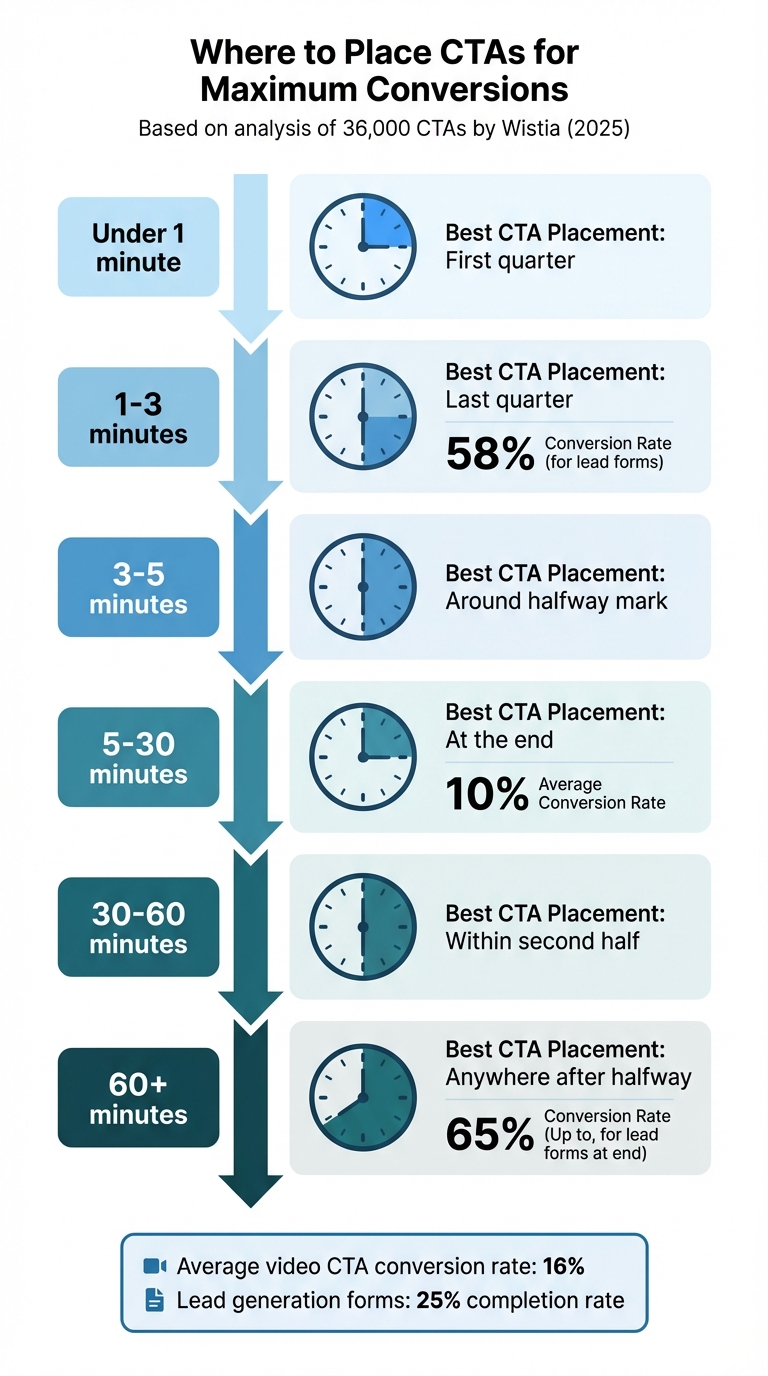
Optimal Video CTA Placement by Video Length for Maximum Conversions
Data from Video Platforms
Research highlights a clear connection between watch time and conversion rates. Videos lasting between 30 and 60 minutes tend to perform best, attracting viewers who are already invested in the content. These engaged viewers are much more likely to take action.
An analysis by Wistia reveals that the average conversion rate for video CTAs is about 16%. However, lead generation forms outperform standard CTAs, with nearly 25% of viewers completing them. The standout statistic? Lead generation forms placed at the end of videos over 60 minutes long can achieve conversion rates as high as 65%. Even shorter videos can perform exceptionally well when optimized - forms placed in the third quarter of 1–3 minute videos yield conversion rates around 58%.
The benefits of longer watch times go beyond direct conversions. For example, pages featuring videos see visitors spending an average of 6 minutes on the page, compared to just 4.3 minutes on pages without videos - a 1.4x increase. This extended engagement provides more chances for your message to resonate and influence purchasing decisions. Next, let’s dive into how video length and content type shape these outcomes further.
How Video Length and Content Type Affect Results
The length and type of video content play a big role in determining watch time and conversions. Videos running between 5 and 30 minutes boast an average conversion rate of 10%, making them effective for nurturing leads and driving sales. The key is aligning video length with your specific marketing goals and audience preferences.
Instructional videos consistently outperform other formats, holding viewer attention even at longer durations. For instance, how-to videos achieve an average engagement rate of 74%, compared to just 43% for standard 3–5 minute videos. Remarkably, viewers stick with over 50% of instructional videos, even when they stretch to 30 minutes. This makes educational content particularly effective for Shopify merchants aiming to showcase product value and build trust with their audience.
Interestingly, short-form videos (3–5 minutes) saw a 10% drop in engagement in 2024, while videos over 30 minutes experienced only a 3% decline. This indicates that audiences still appreciate in-depth, meaningful content when it delivers real value. As Henry Ceiro, Video Content Producer at Dropbox, puts it:
"If you don't hook viewers in five seconds, they're gone. Get straight into the action to make those first moments count".
Here’s a quick guide to matching video length with marketing goals:
| Marketing Goal | Recommended Video Length | Common Video Types |
|---|---|---|
| Brand Awareness | < 1 minute | Promos, teasers, social clips |
| Education/Explanation | 1–5 minutes | How-tos, product demos |
| Conversion/Nurturing | 5–30 minutes | Webinars, walkthroughs, case studies |
| Retention/Training | 30+ minutes | Online courses, full webinars |
Where to Place CTAs and Forms in Videos
Optimizing CTA placement is just as important as creating engaging content. Wistia’s 2025 analysis of 36,000 CTAs provides some key takeaways: the best placement depends on the video’s length.
For videos under one minute, CTAs work best in the first quarter when attention is at its peak. For 1–3 minute videos, the last quarter is the sweet spot. Videos between 5 and 30 minutes see the highest conversion rates when CTAs are placed at the end. For longer content (60+ minutes), CTAs placed anywhere after the halfway point perform well, with the very end capturing the most qualified leads.
Viewers who make it to the end of a video are highly engaged, making them more likely to respond to interactive elements like CTAs or lead generation forms. When placed strategically, CTAs can boost conversion rates to as high as 40%.
Here’s a breakdown of optimal CTA placement by video length:
| Video Length | Best CTA Placement |
|---|---|
| Under 1 minute | Within the first quarter |
| 1–3 minutes | Last quarter of the video |
| 3–5 minutes | Around the halfway mark |
| 5–30 minutes | At the end |
| 30–60 minutes | Within the second half |
| 60+ minutes | Anywhere after halfway |
For Shopify store owners, these insights can be directly applied. For example, if you’re using 2–3 minute product demo videos, place your "Add to Cart" CTA in the final 30 seconds. For longer tutorials or webinars, end with a lead generation form to capture emails from your most engaged viewers. These small adjustments can make a big difference in driving conversions.
sbb-itb-d9e5b3a
Why Watch Time Drives Conversions
Attention and Viewer Commitment
When someone sticks around to watch more than just a few seconds of your video, they're showing genuine interest. And that matters - a lot. Research reveals that viewers who watch at least 30 seconds of a video are 45% more likely to consider a product, 14% more likely to feel favorable toward it, and 19% more likely to make a purchase compared to those who drop off earlier.
Phil Nottingham from Wistia puts it perfectly:
"If we can grasp that we are optimizing for share of mind - the time and consideration spent with your company - Time Watched is the best universal video metric".
Think of it this way: when viewers give you their time, they're also giving you mental space. And it's in that space where decisions are made. While nearly half of a video's impact (47%) happens in the first 3 seconds, the real magic starts when viewers stay engaged past the 30-second mark. That’s when casual interest turns into serious consideration - when they start asking, "Could this product solve my problem?"
Building Trust and Overcoming Objections
Longer videos aren’t just about holding attention - they’re about building trust. And trust is a game-changer. According to shoppers, YouTube content is 1.5x more likely to grab their attention and over 2x as trustworthy as content on other social platforms. That’s a big deal, especially when you’re dealing with products that require more thought, like tech gadgets or home appliances.
Anne Marie Nelson-Bogle, YouTube's VP of Ads Marketing, breaks it down into three key factors:
"Attention is what they give when content captures their interest in a sea of distractions. Relevance is what they feel when that content speaks to their passions and needs. Trust is what they place in voices they find authentic, giving them confidence to make a decision".
Longer watch times give you the opportunity to hit all three of these marks. For shoppers researching high-consideration items - think health trackers, cars, or kitchen appliances - detailed videos are invaluable. They answer questions, address doubts, and provide the reassurance buyers need. In fact, YouTube can shorten the average online shopper’s journey by 6 days. That’s because longer videos save buyers from hunting down answers across multiple sources. Plus, 98% of online users say they trust YouTube creators’ recommendations more than those on other platforms.
When viewers trust your content, they not only engage more deeply but also retain the information that influences their purchase decisions.
Message Retention and Purchase Decisions
There’s a direct link between how long someone watches your video and how well they remember your message. If they stick around, it means your value proposition resonated. If they don’t, it’s likely they left before grasping why your product matters.
This retention plays a huge role in conversions. Globally, 63% of people report buying something online after first seeing it in a YouTube video. By keeping viewers engaged, you give them time to absorb product details, understand its benefits, and imagine themselves using it. Digital video content helps 45% of shoppers decide which product or brand to choose.
The impact isn’t just limited to awareness - it influences every step of the buying process. YouTube is 1.7x more likely to boost brand consideration and 1.6x more likely to drive purchase decisions than social platforms. Videos that run between 5 and 30 minutes average a 10% conversion rate, while ads longer than 1 minute tend to deliver the highest ROI.
In short, when viewers spend more time with your content, they’re not just watching - they’re learning, evaluating, and getting ready to buy. That’s why extended watch time is such a powerful driver of conversions.
How Shopify Merchants Can Use These Insights

Where to Place Videos on Your Store
Embedding videos thoughtfully across your store pages can make a big difference. Product pages, contact pages, course pages, and video galleries are all great candidates for video placement. While product pages may see slightly lower play rates, the viewers who do watch are often highly engaged - exactly the kind of attention you want when influencing purchase decisions. Interestingly, contact pages, course pages, and video galleries tend to have the highest play rates, even outperforming product pages.
For product pages, it’s all about grabbing attention fast. Start strong by presenting the most compelling product benefits within the first 15 seconds to avoid losing viewers early. Instead of relying on a single long video, try using several shorter ones, such as a quick product overview, a how-to guide, and a customer testimonial. This approach often keeps visitors on the page longer than one extended video. Considering that 89% of consumers say watching a video has convinced them to make a purchase, placing videos strategically can have a direct impact on conversions.
Using Shopify Apps to Add and Track Videos
Shopify apps can make video integration seamless while providing tools to track performance. For example, UWidget allows you to embed YouTube videos in various formats like galleries, carousels, sliders, and even sticky video players that follow users as they scroll. Adding videos to product pages has been shown to boost conversion rates by up to 80%.
One major benefit of using apps is maintaining site performance. Features like lazy loading and responsive design ensure your videos don’t slow down your site, helping you keep Core Web Vitals in check. These apps also give you access to detailed metrics, such as Watch Time, Average View Duration, and Audience Retention graphs, so you can see where viewers lose interest and make adjustments.
Real-world examples highlight the effectiveness of video tools. In 2022, Headphonezone.in generated $570,000 in revenue with a 20.2% conversion rate from video shoppers using shoppable video tools. Similarly, APOLLA earned $170,000 with a 10.8% conversion rate after incorporating video widgets. immi reported a 6% conversion rate, bringing in over $57,000 in revenue. Kevin Lee shared his experience:
"VideoWise has significantly increased the dwell time of traffic to our website, which has a multitude of benefits across SEO & increasing the chance of a conversion".
Testing Video Strategies on Your Store
To make the most of video content, testing is key. A/B test everything - from video placement (like above the fold versus in the image gallery) to CTA timing and video formats. Data shows that placing CTAs or lead generation forms at the end of a video is especially effective since viewers who make it to the end are already highly engaged.
Tailor video length to your goals. For a balance between views and engagement, aim for 3 to 4 minutes. That said, longer videos - between 5 and 30 minutes - can achieve a 10% conversion rate when targeting serious buyers.
To keep viewers watching, use pattern interrupts, such as changing visuals, audio, or pacing every 30 to 60 seconds. This technique can reduce drop-offs. Pay attention to audience retention graphs to identify where viewers lose interest and refine your content accordingly. For longer videos, include chapter markers so viewers can jump to specific sections. This small addition can improve satisfaction and boost overall watch time.
Conclusion
Watch Time as a Conversion Driver
Studies reveal that longer watch times lead to better conversions. Visitors who engage with videos for extended periods not only spend 1.4 times more time on pages but also develop the trust needed to make purchases. This deeper engagement plays a significant role in driving conversions - 93% of businesses report that video marketing delivers conversion rates that match or exceed other content types. The additional time spent watching provides potential customers with a chance to learn about your products, build confidence, and address any hesitations before completing their purchase.
Next Steps for Shopify Store Owners
To increase engagement, add videos to critical pages like product, contact, and course pages. Tools like UWidget can help you incorporate features such as video galleries, carousels, or sticky players. Grab viewers’ attention within the first 15 seconds, and position your calls-to-action (CTAs) at the end of videos, where engagement peaks. Research shows that lead generation forms placed at this point can achieve conversion rates as high as 65% for long-form content. Leverage Shopify analytics and audience retention graphs to pinpoint where viewers drop off, so you can make data-driven improvements.
Keep Testing and Improving
Effective video marketing demands continuous optimization. Experiment with video placement, thumbnail designs, CTA timing, and length to find what resonates most with your audience. Use techniques like pattern interrupts every 30–60 seconds and chapter markers to keep viewers engaged and give them the option to jump to specific sections. Analyze retention graphs closely and tweak your content to address drop-off points. Brands like Sulwhasoo, which achieved a 91% decrease in CPA and a 13.8X boost in conversion rate, demonstrate the power of refining strategies based on real-world performance data. Constant improvement is the key to staying ahead.
FAQs
How does video watch time affect conversion rates?
Video watch time is a key factor in boosting conversions. When people spend more time watching your video, it shows they’re engaged, which helps your brand’s message stick. This stronger connection makes it more likely they’ll take action - whether that’s buying a product or signing up for a service.
On top of that, platforms that prioritize engagement metrics tend to favor videos with longer watch times. This means your content could reach more people, amplifying its impact and increasing the chances of turning viewers into customers.
What are the best ways to add CTAs in videos to drive more conversions?
To make your video calls-to-action (CTAs) more impactful and drive conversions, consider these practical tips:
- Time it perfectly: Place your CTA right after sharing key insights or delivering value. This is when your audience is most engaged and likely to take action.
- Make it stand out: Use a bold button or overlay that’s easy to spot but doesn’t take away from your content.
- Keep the language sharp and action-focused: Use phrases like “Shop Now”, “Learn More”, or “Claim Your Offer”. Pairing these with a clear benefit can create a sense of urgency.
- Match it to the video’s goal: Align your CTA with the viewer’s position in the funnel. For example, use “Download the Guide” for informational videos or “Buy Now” for product showcases.
- Test and tweak: Run A/B tests to experiment with different placements, designs, and wording to see what resonates best with your audience.
A well-timed, clear, and audience-focused CTA can make all the difference in turning viewers into loyal customers.
How does video watch time influence engagement and conversions?
Videos that keep viewers watching longer tend to drive better engagement and lead to more conversions. Why? Because when you hold someone’s attention for an extended period, they’re more likely to fully understand your message, connect with it, and feel inspired to take action.
On top of that, many platforms reward videos with higher watch times by giving them more visibility. This means your content is more likely to be discovered by a broader audience. By producing engaging, longer-form videos, you not only give viewers the time to build trust in your brand but also help them make well-informed decisions - leading to a noticeable boost in conversions.