Yes, they do. Interactive videos are changing how people shop online by combining browsing, adding to cart, and checkout into one smooth process. With features like clickable product tags and in-video purchases, they help reduce cart abandonment and increase sales. Here's why they work:
- Higher Conversion Rates: Brands like Ava Estell saw a 300% boost in conversions, while Fashion Floor achieved a 33% increase.
- Improved Engagement: Viewers spend 47% more time on interactive videos and are 66% more likely to interact with them.
- Reduced Cart Abandonment: By simplifying the buying process and building confidence with detailed product views, abandonment rates drop significantly.
Interactive videos keep customers engaged and confident, leading to fewer lost sales and higher revenue. If you're in e-commerce, this is a tool worth exploring.
What Are Interactive Shoppable Videos?
Basic Definition and Features
Interactive shoppable videos turn passive watching into an active shopping experience. Instead of just viewing a product video and then searching for the item on a separate platform, shoppable videos let you click, explore, and buy - all within the video itself.
These videos include interactive hotspots that highlight products. Clicking on one reveals details like pricing and an "Add to Cart" button. This feature, known as product tagging, connects the items in the video directly to the store's inventory. Some videos also include advanced branching options, allowing viewers to choose different paths based on their interests, which personalizes the experience and helps keep potential buyers engaged.
The impact is clear: viewers spend 47% more time watching interactive videos than traditional ones, and 41% of viewers add items to their cart directly through the video. These features not only make the content more engaging but also simplify the buying process dramatically.
How They Simplify the Buying Process
Traditional online shopping often involves multiple steps, each offering a chance for potential buyers to leave the process. Shoppable videos remove these barriers by combining discovery and purchase into a single, uninterrupted flow.
"Instead of interrupting the shopping journey with multiple redirects and page loads... shoppable interactive videos keep customers engaged in a single, compelling experience." - Natalia Petrova, Video Marketer, Firework
With these videos, customers can choose options like size and color, and add items to their cart without ever leaving the video. For instance, Samsung's interactive video campaigns achieved a 22% increase in conversions, while skincare brand Ava Estell reported a staggering 300% boost in conversion rates. By cutting down on unnecessary steps, shoppable videos directly address the common issue of cart abandonment.
The Link to Cart Abandonment
Mobile cart abandonment rates are shockingly high, sitting at 85.6%. Every redirect, extra page load, or moment of hesitation adds to this problem.
Shoppable videos tackle this issue head-on by streamlining the entire process. With fewer steps between discovering a product and completing a purchase, customers are less likely to abandon their carts. For example, when ASOS used videos to showcase how clothes move on real models, they saw a 30% drop in return rates - customers felt more confident in their purchases.
The numbers speak for themselves: interactive videos boast a 90% completion rate, compared to just 58% for traditional videos, and they generate 66% more engagement. By keeping viewers engaged and confident, these videos reduce abandonment triggers and encourage follow-through on purchases.
Watch and Shop: How to sell direct through interactive video
Research Data: How Shoppable Videos Affect Sales and Engagement
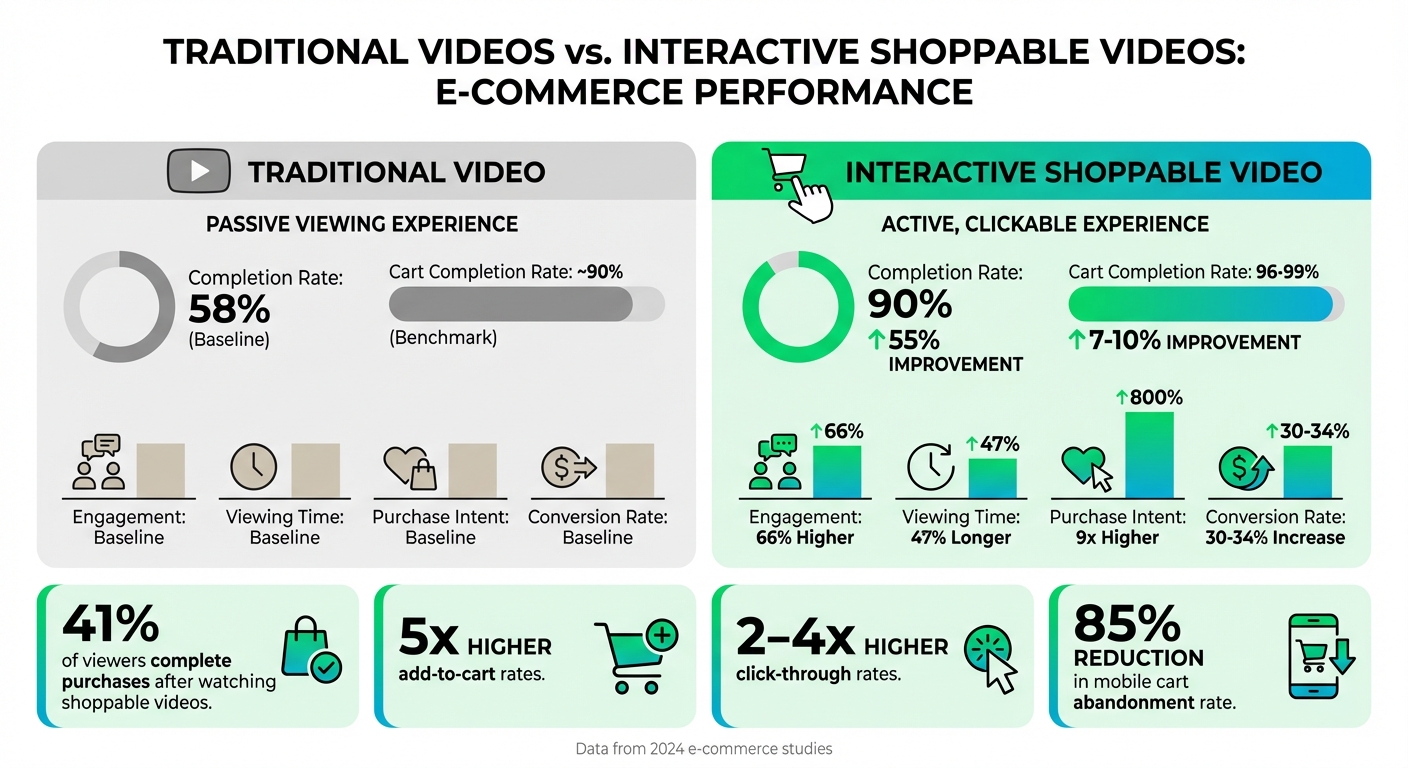
Traditional vs Interactive Shoppable Videos: Performance Comparison
Higher Engagement and Purchase Intent
Shoppable videos are proving to be game-changers, delivering 9x higher purchase intent while keeping viewers engaged for 47% longer and boosting interaction rates by 66%. Even more impressive, interactive videos can achieve completion rates as high as 90%.
When it comes to cart behavior, the numbers speak volumes. While the industry standard for clicks-to-populated carts is around 90%, interactive shoppable videos consistently outperform, hitting rates between 96% and 99%. Jennifer Silverberg, CEO of SmartCommerce, highlights this success:
"Network-wide, the benchmark for clicks-to-populated carts is 90%, but with KERV's Interactive and Shoppable video, we consistently see completes between 96-99%, meaning that their engagement-based, in-video clicks are driving highly qualified and motivated shoppers."
Conversion Rate Changes
In June 2024, skincare brand Ava Estell experienced a staggering 300% increase in conversion rates after integrating shoppable videos into their site via the Videowise platform. Similarly, organic soap brand Dr. Squatch saw their conversion rates climb by 9.9% through the use of shoppable user-generated content.
The fashion world is also tapping into this trend. Over a 30-day period in 2024, Fashion Floor incorporated shoppable videos into their Shopify store and achieved a 33% boost in conversions. On average, e-commerce sites using video enjoy 34% higher conversion rates, while shoppable videos specifically deliver 2-4x higher click-through rates compared to traditional product videos. A standout example comes from Ted Baker, which launched an eight-episode interactive sitcom, "Keeping Up with the Bakers," allowing viewers to click and purchase products featured in the storyline. This creative approach led to a 30% increase in sales. Additionally, live video shopping has been shown to drive 49% higher average order values.
Impact on Cart Abandonment Rates
Shoppable videos not only capture attention but also encourage action. They generate 5x higher add-to-cart rates and drive purchases for 41% of viewers.
For instance, an automotive campaign by the Southern California Toyota Dealers Association, spearheaded by John Papadopoulos at Davis Elen Advertising, used interactive product cards overlaid on video assets. The result? A 33-point lift in purchase consideration and an 85% increase in new vehicle registrations for the bZ4X model. Sephora also demonstrated the power of combining augmented reality with shoppable content through their "Virtual Artist" feature. This tool allowed customers to virtually try on makeup, leading to an 80% jump in conversion rates for featured products.
| Metric | Traditional Video | Shoppable/Interactive Video |
|---|---|---|
| Purchase Intent | Baseline | 9x Higher |
| Viewing Time | Baseline | 47% Longer |
| Engagement Rate | Baseline | 66% Higher |
| Cart Completion Rate | ~90% (Benchmark) | 96% - 99% |
| Conversion Rate | Baseline | 30% - 34% Increase |
These metrics highlight the transformative potential of shoppable videos, paving the way for deeper insights into measuring and optimizing their performance.
sbb-itb-d9e5b3a
How Shoppable Videos Solve Cart Abandonment Problems
Shoppable videos do more than just simplify the shopping experience - they actively address cart abandonment with three smart strategies.
Fewer Steps to Complete Purchase
Online shopping often feels like a maze. Shoppers navigate from product discovery to product pages, then to their cart, and finally to checkout. Each extra step increases the chance they'll abandon their cart - by about 10% per step. Shoppable videos change the game by letting viewers add items to their cart or buy with a single tap, all without leaving the video.
"The magic lies in its seamlessness. Instead of interrupting the shopping journey with multiple redirects and page loads, shoppable interactive videos keep customers engaged in a single, compelling experience that naturally flows to checkout."
This approach is especially impactful on mobile devices, where cart abandonment rates soar to 85.6%, compared to 73.1% on desktops. Features like vertical video formats and thumb-friendly hotspots make the mobile experience smoother. Since 70% of shoppers quit due to frustrating checkout processes, reducing steps not only speeds things up but also builds trust, giving shoppers more confidence to complete their purchase.
Increasing Buyer Confidence
One big challenge in online shopping is hesitation - shoppers can’t touch or try products, which often leads to second thoughts. Shoppable videos help overcome this by showing products in action, offering multiple angles, and providing context that static photos just can’t deliver.
Take ASOS, for example. They added video showcases for their clothing line, letting customers see how items fit and move on real models. The result? A 30% drop in return rates as shoppers felt more confident about their purchases. Similarly, Wayfair used AR videos to let customers visualize furniture in their homes, cutting return rates by 25%.
Video content is already a go-to for shoppers - 85% of consumers use it to make buying decisions, and 70% want to see at least 3–5 product views before committing. Shoppable videos make this effortless by adding overlays with quick access to size guides, prices, and specs, all without interrupting the video. The result? Fewer doubts, more trust, and fewer abandoned carts.
Winning Back Abandoned Carts
Cart abandonment costs retailers a staggering $18 billion every year. Shoppable videos offer a direct way to claw back some of those losses. By embedding these videos in retargeting emails or SMS campaigns, brands can let customers pick up right where they left off - no need to fight through a clunky website.
One retailer saw a 33% boost in conversions by embedding shoppable videos in their retargeting efforts. These videos eliminate common obstacles like complicated navigation and slow page loads, making it easy for customers to complete their purchase.
Even better, machine learning can predict when a customer might abandon their cart by analyzing hesitation signals. Predictive analytics in video commerce has been shown to reduce cart abandonment by up to 35%, turning potential losses into completed sales through well-timed, personalized follow-ups.
How to Measure Shoppable Video Performance
Keeping an eye on the right metrics is key to understanding how effective your shoppable videos are at reducing cart abandonment. Focus on three main areas: engagement (how viewers interact with your video), conversion (how many viewers actually make a purchase), and financial performance (the revenue your videos bring in).
Important Metrics to Monitor
- Add-to-Cart Rate: This shows the percentage of viewers who add a product to their cart directly from your video. It’s a strong indicator of immediate buying intent.
- Click-Through Rate (CTR): This measures how many viewers click on product tags or calls-to-action. A high CTR paired with a low conversion rate might point to issues on your landing page or a disconnect between the video’s message and the product page.
- View-Through Rate (VTR): This metric tracks where viewers drop off while watching your video. If they leave before seeing your product tags, they’re unlikely to reach checkout.
- Revenue Per Click (RPC): This calculates the total revenue generated per click on your video elements, helping you assess the quality of traffic reaching your checkout page.
For example, in 2024, Dr. Dennis Gross Skincare used these metrics to refine their approach, achieving an 8.2% conversion rate and generating $1 million in revenue. Similarly, Ava Estell leveraged Videowise to track performance, leading to a 23% engagement rate and 21% conversion rate, which translated to an additional $892,000 in revenue.
| Metric | What It Measures | Why It Matters for Cart Abandonment |
|---|---|---|
| Add-to-Cart Rate | % of viewers adding products from the video | Shows immediate buying intent before abandonment occurs |
| Click-Through Rate | % of viewers clicking product tags or CTAs | Indicates whether your video motivates viewers to take action |
| View-Through Rate | % of viewers watching 75–100% of the video | Highlights if viewers see product tags or drop off too early |
| Conversion Rate | % of viewers completing a purchase | Measures how well your video reduces cart abandonment |
| Revenue Per Click | Total revenue ÷ number of clicks | Evaluates the value of traffic sent to checkout |
Once you’ve identified these metrics, you can start testing ways to improve them.
Testing Different Approaches
A/B testing is a great way to see what works best. Compare shoppable videos with standard ones, but change only one variable at a time. For instance, one beauty brand found that placing product tags in the bottom-right corner of the video increased CTR by 15% compared to center placements. You can also experiment with timing - adding product tags within the first 15 seconds of the video can capture viewers while their attention is highest.
If your VTR is low, consider shortening the video to keep viewers engaged. If CTR is high but conversions fall short, it might be time to review your checkout process for potential friction points. Breaking down your data by video type (e.g., tutorials versus unboxings) or placement (e.g., homepage versus product page) can also reveal which combinations drive the most sales.
Alongside testing, using specialized tools can help you gather even deeper insights.
Using Shopify Apps for Better Data

If you’re running a Shopify store, several apps can help you track and optimize video performance.
- UWidget: This app lets you showcase YouTube videos as galleries, carousels, or sticky players, making it easier to feature products while tracking engagement.
- CheckIt: Adds a progress bar to your checkout process, giving customers a clear view of where they are in their purchase journey and reducing cart abandonment.
- ILikeThat: Adds "like" buttons for products, capturing customer interest even before they add items to their cart.
Conclusion: Do Shoppable Videos Work?
Shoppable videos are proving to be a game-changer for reducing cart abandonment and boosting sales. With an impressive 96-99% clicks-to-populated-cart rate, far exceeding the standard 90% benchmark, these videos attract highly motivated shoppers. Even better, 41% of viewers complete purchases after watching shoppable content. E-commerce platforms using these videos experience 34% higher conversion rates on average.
Brands have reported conversion rate increases ranging from 10% to a staggering 300%. These numbers clearly show that eliminating friction in the shopping journey leads to greater engagement and more sales.
What makes shoppable videos so effective? They tackle the main reasons for cart abandonment: product uncertainty, complex checkout processes, and the gap between inspiration and action. By streamlining the shopping experience into one cohesive flow, these videos keep customers engaged and confident, right up to completing their purchase. This integrated approach not only builds trust but also highlights areas for further optimization.
If you’re using Shopify, consider experimenting with shoppable videos for your top-selling products. Track key metrics like add-to-cart rates, conversion rates, and revenue per click to measure the impact. Tools like UWidget can help you showcase video content effectively, while CheckIt ensures a smooth and transparent checkout process. The evidence is clear - shoppable videos are reshaping the way customers shop and buy online.
FAQs
How do interactive videos help boost e-commerce sales?
Interactive videos work wonders for boosting sales by drawing shoppers in and offering a smoother shopping journey. Research shows they can generate up to 66% more interaction and increase view times by 44%, keeping viewers engaged for longer stretches.
What makes them stand out? The ability to embed clickable, shoppable elements right into the video. This lets customers explore and buy products instantly, cutting down on steps and making the buying process easier. The result? A noticeable boost in add-to-cart rates. In fact, 71% of shoppers say interactive videos play a key role in their purchase decisions. These features help lower cart abandonment and turn more browsers into buyers.
How do shoppable videos help reduce cart abandonment?
Shoppable videos make online shopping more intuitive by letting users shop directly within the video. Features like clickable product hotspots let viewers explore details - such as price, size, or color - and add items to their cart without ever leaving the video. Integrated checkout overlays take it a step further, allowing users to complete their purchase right then and there, eliminating the need to visit a separate product page.
These videos do more than just showcase products - they bring them to life. By showing items in action, they help shoppers picture how a product might fit into their lives, reducing uncertainty and encouraging quicker decisions. The interactive elements keep viewers engaged longer, dramatically increasing the likelihood of a purchase. Paired with clear calls-to-action and real-time product details, like availability and quick-add buttons, the journey from interest to checkout becomes almost instant, cutting down hesitation and driving up conversions.
How can I evaluate the effectiveness of shoppable videos in my e-commerce store?
To gauge how well shoppable videos are performing, keep an eye on some key metrics. For instance, average view duration is a big one - interactive videos tend to keep viewers engaged about 44% longer. Another important factor is engagement rates, which can be as much as 66% higher. Metrics like hotspot click-through rates, add-to-cart percentages (with roughly 41% of viewers adding items), and conversion rates (potentially 34% higher than static media) are also essential to track.
By comparing these numbers to your store's usual performance, you can get a clear picture of how shoppable videos are influencing customer behavior and driving sales. This data is invaluable for fine-tuning your approach and getting the most out of your efforts.