Responsive video widgets are a game-changer for e-commerce stores aiming to boost sales. They solve common problems like broken video displays on mobile devices and slow page load times, which can harm conversions. By automatically resizing to fit any screen and offering interactive features like shoppable videos, these widgets enhance the shopping experience and drive results:
- Shoppable videos: Boost conversion rates by 35% and increase revenue per session by 20%.
- Mobile optimization: Over 50% of online traffic comes from mobile, making responsive design essential.
- Faster load times: Lazy loading reduces delays, preventing a 20% drop in conversions from slow pages.
For Shopify store owners, options include specialized tools like UWidget, generic responsive widgets, and static video embeds. Each option offers varying levels of ease, features, and impact on conversions. The right choice depends on your goals and budget.
Key takeaway: Investing in responsive video widgets can significantly improve engagement and sales, especially for mobile shoppers.
How Responsive Video Widgets Increase Conversions
Static video embeds often come with their own set of challenges, especially when it comes to mobile users. Enter responsive video widgets, which not only solve these issues but also deliver measurable boosts to conversions. Unlike static embeds that can break on mobile devices - leading to horizontal scrolling and cut-off content - responsive widgets automatically adjust their dimensions using media queries, ensuring seamless display across all devices. This mobile-friendly approach is a game-changer, paving the way for better performance and user satisfaction.
Another key advantage of responsive widgets is their use of lazy loading and external hosting, which keeps page speeds fast. Static embeds, on the other hand, can slow down your site, and that’s a problem since every one-second delay in load time can reduce conversions by 20%. For example, jewelry brand Winterson saw dramatic results after incorporating product videos into their pages:
"We have tested and proven that when someone watches our video reviews they're 120.5% more likely to buy, spend 157.2% longer on the site and spend 9.1% more per order".
Responsive widgets also shine with their shoppable functionality, allowing users to add products directly to their cart while watching a video. This eliminates the need for customers to remember product details or navigate away, a common limitation of static embeds. Puma saw remarkable results with this approach, achieving an earnings-per-click rate 24 times higher than the e-commerce industry average.
The format of the video matters, too. Vertical videos, which responsive widgets handle effortlessly, align with how people naturally hold their phones and drive 130% higher engagement rates compared to horizontal formats. Add interactive elements to the mix, and user activity can jump by 591%, turning passive viewers into active shoppers. Overall, responsive video widgets can boost store conversions by up to 3.5×. Shoppable features alone have been shown to increase conversion rates by 30% and multiply purchase intent by 9×.
Here’s a quick look at how different types of videos can impact key metrics:
| Video Type | Primary Impact Area | Potential Metric Improvement |
|---|---|---|
| Product Demos | Conversion Rate | +15–25% Add-to-Carts |
| How-To & Tutorials | Product Understanding | +30% Time on Page |
| Customer Testimonials | Trust & Social Proof | –20% Cart Abandonment |
| Brand Story Videos | Customer Loyalty | +10% Repeat Purchases |
Responsive video widgets don’t just fix the shortcomings of static embeds - they actively enhance the shopping experience, driving higher engagement and better conversion performance. These benefits make them an essential tool for businesses looking to improve their digital presence.
1. Fractal Apps: UWidget
Conversion Impact
UWidget transforms YouTube content into a shopping experience by letting merchants tag products directly in videos and Shorts. This creates a smooth "watch and buy" flow, which is crucial since 64% of consumers are more likely to purchase a product online after watching a video about it. By addressing the mobile and speed challenges discussed earlier, UWidget introduces features like sticky players, carousel sliders, and video banners that keep videos visible even while users scroll. These elements can mean the difference between securing a sale or losing a potential customer. Plus, its mobile optimization ensures these features work seamlessly across all devices.
Mobile Responsiveness
When it comes to mobile video, UWidget takes care of the technical headaches. It’s designed to support YouTube Shorts natively, optimizing vertical videos without those annoying black bars or awkward scaling issues typical of standard 16:9 embeds. Its responsive design ensures that video galleries, carousels, and grids adapt perfectly to any screen size. Wholesale Nursery Co, a verified merchant, shared their experience:
"It allows shorts and videos to be displayed and easily integrated on my e-commerce store".
Technical Features
To maintain fast page load times, UWidget uses a thumbnail-first, lazy-loading approach, ensuring videos only load when they’re visible. This is important because websites that load in just one second have a conversion rate 2.5 times higher than those that take five seconds. For merchants who want more control, UWidget supports custom CSS, allowing them to tweak the widget’s appearance for different screen sizes. With a perfect 5.0/5 rating on the Shopify App Store, users frequently highlight its smooth integration and functionality. Despite its robust technical capabilities, the app is designed to be user-friendly, requiring no coding skills.
Ease of Implementation
Getting started with UWidget is straightforward - just paste the YouTube URL, adjust the settings, and publish in minutes. Pricing is accessible, starting at $5.99/month for the Starter plan (1 widget, 25 videos), $13.99/month for Pro (3 widgets, 50 videos), and $19.99/month for Premium (unlimited widgets and videos). All plans include a 7-day free trial and offer a 17% discount for annual billing.
2. Generic Responsive Video Widgets
Conversion Impact
Generic responsive video widgets can significantly boost conversions by addressing the limitations of static video embeds. Properly displaying videos across all devices ensures a polished, professional look that keeps visitors engaged. This is crucial because video content can increase conversion rates by up to 80% and influence the purchasing decisions of 90% of consumers. These widgets automatically adjust to fit any screen size, eliminating problems like horizontal scrolling or awkward formatting - issues that often lead to higher bounce rates. This seamless adaptability is especially beneficial for mobile users.
Mobile Responsiveness
With mobile devices accounting for over 50% of all online traffic, ensuring videos perform well on smaller screens is essential. Generic responsive widgets ensure consistent viewing experiences by maintaining a 16:9 aspect ratio and offering a touch-friendly interface. This eliminates the need for users to pinch, zoom, or rotate their devices. As the Moast Team aptly puts it:
"A video that doesn't work perfectly on mobile is worse than no video at all. It signals a lack of care and can quickly erode customer trust in your brand".
Technical Features
Modern responsive widgets utilize advanced CSS properties like aspect-ratio for cleaner, more efficient code, moving away from outdated padding-based methods. They also incorporate lazy loading (loading="lazy") to improve page speed by delaying video loading until it’s actually visible on the screen. This not only enhances initial load times but also positively impacts Core Web Vitals. By integrating with external platforms like YouTube or Vimeo, these widgets take advantage of global CDNs to reduce buffering and server strain. Additional features, such as custom thumbnails, can boost video play rates by 7%, while closed captions cater to the 85% of mobile viewers who watch videos without sound. Together, these features make responsive video widgets a practical and efficient solution.
Ease of Implementation
Making videos fit seamlessly into a site’s design has never been easier. Unlike static embeds that require merchants to manually tweak HTML and CSS - often resorting to complex "padding-hack" techniques - generic responsive video widgets simplify the process. Apps like Easy Responsive Videos & Maps allow merchants to create responsive video displays in seconds, all for just $2/month. The setup is straightforward: install the app, paste the video URL, and publish - no coding skills required. This accessibility makes it a valuable tool for any e-commerce store.
sbb-itb-d9e5b3a
3. Static Video Embeds
Conversion Impact
Static video embeds, created with simple copy-and-paste iFrame codes, provide a passive viewing experience. This lack of interactivity can significantly limit their ability to drive conversions. In fact, interactive videos have been shown to boost conversion rates by up to 70% compared to static content. On the flip side, unoptimized static embeds can slow down mobile page load times - just a one-second delay can cause conversion rates to plummet by as much as 20%.
Mobile Responsiveness
One of the biggest drawbacks of static embeds is their poor performance on mobile devices. They often disrupt layouts, leading to cut-off content and the dreaded horizontal scrolling experience. This happens because standard iFrame codes rely on fixed width and height values, which don't adapt to different screen sizes. With mobile devices now accounting for 38.5% of e-commerce sales, these issues can directly impact revenue. Moreover, static embeds aren’t designed for the vertical, swipe-friendly formats that today’s shoppers prefer. As previously mentioned, poor mobile experiences can damage customer trust and hurt long-term sales.
Technical Features
Static embeds come with their fair share of technical headaches. To make them responsive, merchants often need to tweak CSS manually. This might involve using outdated methods like the "padding-bottom" hack (setting padding to 56.25% for a 16:9 ratio) or the more modern aspect-ratio property paired with width: 100%. If the loading="lazy" attribute isn’t added to the iFrame, the video will load immediately, slowing down the entire page and negatively affecting Core Web Vitals. Hosting videos directly on Shopify’s servers instead of external platforms further drags down site speed. Another limitation is that static embeds don’t handle automatic compression or generate video schema markup, which means search engines can’t display them in rich snippets. While static embeds are straightforward to use, these technical drawbacks highlight why they often fall short in driving meaningful results.
Ease of Implementation
The simplicity of static embeds is both their strength and their weakness. Embedding a video from platforms like YouTube or Vimeo is as easy as pasting a code - no coding expertise required. This makes them an accessible option for merchants looking to quickly add videos to product pages or blog posts. However, managing static embeds across a large catalog of products can quickly become a time-consuming task. Without bulk embedding tools, each embed must be manually adjusted to ensure it works properly on mobile devices. Additionally, static embeds lack built-in analytics, leaving store owners unable to track engagement or tie video performance directly to revenue. This makes it challenging to measure their true impact on conversions.
Pros and Cons
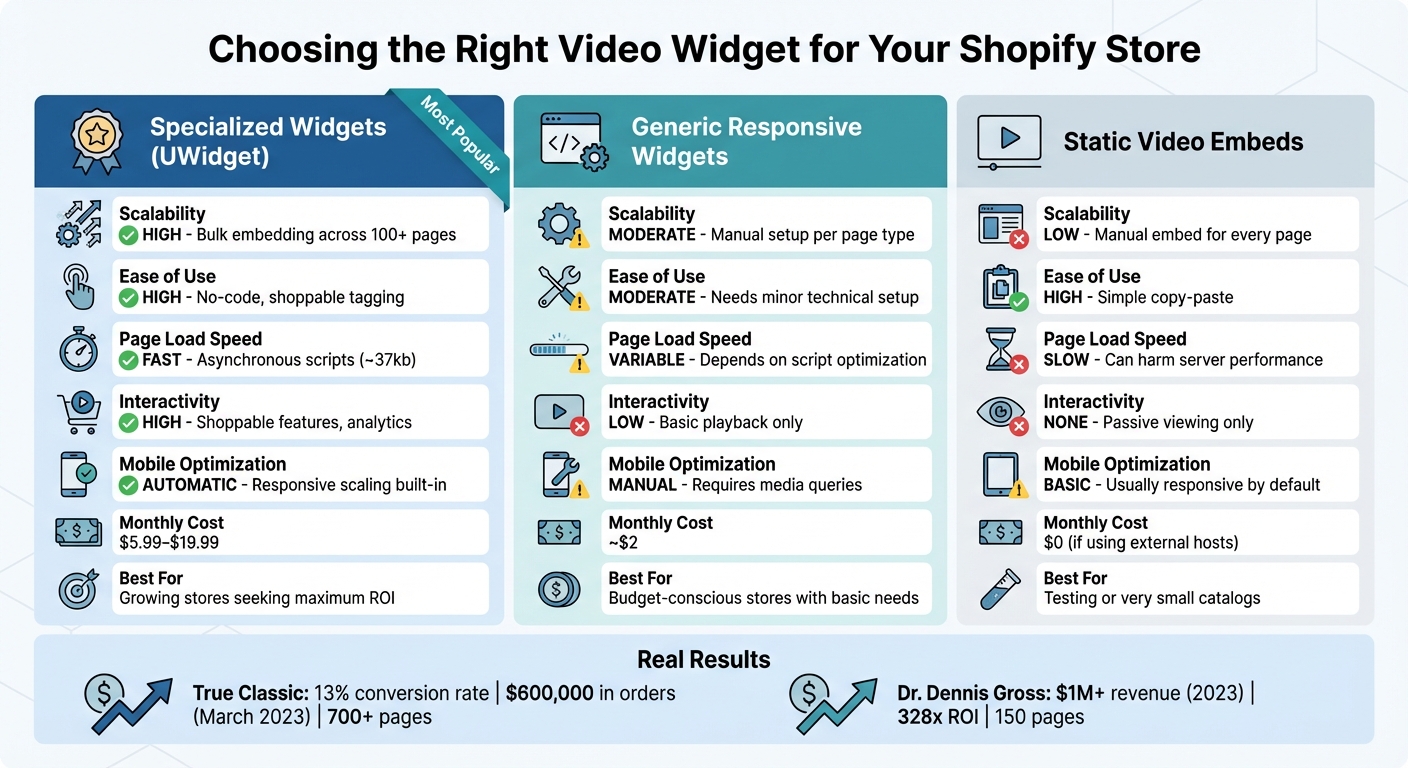
Shopify Video Widget Comparison: Features, Costs, and Performance
This section breaks down the benefits and limitations of different video integration methods, highlighting how each approach impacts performance and revenue. Every solution comes with trade-offs, so understanding these nuances is key to making the right choice.
Specialized responsive widgets, like UWidget, pack powerful features and deliver strong performance. They’re ideal for scalability, allowing bulk embedding across hundreds of pages. With no-code interfaces and shoppable tagging, they’re easy to implement. However, these advantages come at a cost - subscriptions range from $5.99 to $19.99 per month. For businesses willing to invest, these widgets offer advanced interactivity and analytics to drive conversions.
Generic responsive widgets strike a balance between affordability and functionality. Priced at around $2 per month, they handle basic responsiveness across devices. But there’s a catch - manual configuration is often needed for different page types, which can be time-consuming. Additionally, their scripts aren’t optimized for e-commerce, potentially increasing Total Blocking Time and slowing site performance. Without features like product tagging or built-in analytics, their ability to boost conversions is limited.
Static video embeds are the most straightforward option. Simply copying and pasting embed codes from platforms like YouTube or Vimeo gets the job done. They’re free, making them a go-to for budget-conscious merchants. But simplicity has its downsides. For large catalogs, manual embedding becomes impractical. Static embeds also lack interactivity, offering only passive video experiences. Worse, without lazy loading, they can significantly slow down page load times. Uploading video files directly to Shopify can cripple your site’s speed.
| Feature | Specialized Widgets (UWidget) | Generic Responsive Widgets | Static Video Embeds |
|---|---|---|---|
| Scalability | High: Bulk embedding across 100+ pages | Moderate: Manual setup per page type | Low: Manual embed for every page |
| Ease of Use | High: No-code, shoppable tagging | Moderate: Needs minor technical setup | High: Simple copy-paste |
| Page Load Speed | Fast: Asynchronous scripts (~37kb) | Variable: Depends on script optimization | Slow: Can harm server performance |
| Interactivity | High: Shoppable features, analytics | Low: Basic playback only | None: Passive viewing |
| Mobile Optimization | Automatic: Responsive scaling built-in | Manual: Requires media queries | Basic: Usually responsive by default |
| Monthly Cost | $5.99–$19.99 | ~$2 | $0 (if using external hosts) |
The numbers tell a compelling story. For example, True Classic achieved a 13% conversion rate and generated $600,000 in orders in March 2023 by using specialized widgets with asynchronous scripts across more than 700 pages. Similarly, Dr. Dennis Gross saw over $1 million in revenue in 2023 by leveraging bulk embedding across 150 pages, achieving an impressive 328x ROI. These examples highlight how optimized, interactive video solutions can significantly outperform basic embedding methods for e-commerce businesses aiming for growth.
Conclusion
Responsive video widgets have become a game-changer for Shopify stores aiming to drive conversions. The numbers speak for themselves: 91% of consumers watch videos to learn about products before buying, and landing pages featuring videos can see conversion rates soar by up to 80%. When you combine mobile-friendly design, shoppable features, and efficient performance, the potential impact on your sales is impossible to ignore.
Choosing the right video solution depends on your business goals and available resources. While static embeds are free, they lack the interactivity and scalability necessary for growth. Generic widgets offer more flexibility but often require manual setup and fall short on features tailored for e-commerce. On the other hand, specialized tools like UWidget provide a robust solution. With features like shoppable tagging, bulk embedding, and performance optimization, UWidget ensures your videos engage customers without slowing down your site.
For merchants ready to scale, investing in a specialized widget pays off quickly. UWidget, for example, simplifies the process with tools that create seamless, conversion-focused video experiences. Features like product tagging directly within videos, automatic mobile responsiveness, and lazy loading help reduce friction in the buying process while maintaining fast page speeds.
As highlighted earlier, stores that embrace responsive, interactive video content consistently outperform those sticking to basic embedding methods. Whether you're showcasing product demos, customer testimonials, or tutorials, the right video widget can turn passive viewers into active buyers. With 77% of e-commerce traffic now coming from mobile devices, responsive video integration isn’t just an option - it’s the edge that sets successful stores apart in today’s competitive landscape.
FAQs
How do responsive video widgets enhance mobile shopping experiences?
Responsive video widgets are a game-changer for mobile shopping, ensuring that video content adapts effortlessly to any screen size or device. This means no more clunky formatting or frustrating load times - just a smooth, user-friendly experience that makes it easy for customers to interact with videos on their smartphones or tablets.
These widgets shine when it comes to delivering visually engaging content like product demos, customer testimonials, or brand stories. They grab attention, build trust, and encourage users to dive deeper into your offerings. The result? Shoppers spend more time on your site, explore products more thoroughly, and are more likely to make a purchase - all of which can lead to higher conversions in today’s mobile-driven world.
How do shoppable videos help boost e-commerce sales?
Shoppable videos offer e-commerce stores an engaging and interactive way to showcase products. Unlike static images or traditional ads, these videos capture attention for longer periods, allowing viewers to explore products in a more immersive setting. The result? Higher conversion rates, as customers can click directly on featured products within the video to view details or make a purchase - without extra steps.
What makes shoppable videos stand out is their ability to present products in real-world scenarios. This approach feels especially relatable to video-focused audiences like Millennials and Gen Z, making the shopping experience feel natural and approachable. Adding shoppable videos to your store can simplify the buying process, boost customer interaction, and, most importantly, drive sales.
Why is lazy loading essential for video widgets on Shopify stores?
Lazy loading plays a key role in video widgets by boosting website performance. It works by loading videos only when they’re nearly in view, which cuts down on initial page load times. This keeps visitors from getting frustrated with slow-loading pages and encourages them to stay on your site.
When load times are optimized, the user experience improves significantly. Visitors are more likely to browse longer, which can lead to better engagement and even higher conversion rates. Plus, faster-loading pages can give your SEO a boost, making your site more likely to appear in front of potential customers.