Shoppable videos let viewers shop directly within a video using interactive elements like "Shop Now" buttons, product tags, or hotspots. These videos are transforming online shopping by making it more engaging and convenient. Here's why they work:
- 380% more clicks with integrated CTAs.
- 41% of viewers add items to their cart.
- 9x increase in purchase intent.
Brands across industries are using these videos effectively:
- Fashion: Multi-product tagging for outfit showcases boosts conversions by up to 141%.
- Home Goods: IKEA uses product hotspots to create immersive shopping experiences, achieving a 460% ROAS.
- Cooking: Ingredient tags simplify multi-item purchases, with Walmart seeing a 71% engagement rate.
- Live Shopping: Events drive urgency, with conversion rates 60% higher than regular e-commerce.
- Beauty: Discount overlays paired with product demos increase conversions by 3-4x.
Design tips include placing CTAs in the bottom right corner, using bright colors, and timing them between 21 and 34 seconds for peak engagement. Tools like UWidget help Shopify store owners integrate these features, starting at $5.99/month.
Shoppable videos are not just about clicks - they build trust, shorten the path to purchase, and drive results.
1. Fashion Brand Outfit Showcase with 'Shop Now' Buttons
CTA Type
Fashion outfit showcases thrive with multi-product tagging, allowing viewers to click on individual items - like shoes, tops, or accessories - directly from a single video frame. Instead of leading shoppers away from the video, quick add-to-cart buttons keep them engaged while simplifying the checkout process. Another effective method is using floating CTAs that follow specific products as they appear on screen, ensuring a clear connection between the item and its purchase option.
These strategies create a seamless blend of style inspiration and instant shopping opportunities, keeping viewers engaged while encouraging purchases.
Best Video Context
These CTAs work exceptionally well in style tutorials or outfit assembly videos where viewers can see how different pieces come together. For example, SEFI, a fashion brand, used Clipara to add shoppable video stories to their Shopify store. These videos showcased their activewear in action, leading to conversion rates as high as 21% with over 20,000 video views. This demonstrates how tailored CTAs can drive a cohesive and effective video marketing strategy.
Reported Impact
The results speak for themselves. Fashion brand Natori saw a 141% increase in conversion rates after introducing shoppable video content. Additionally, 64% of shoppers are more inclined to make a purchase after watching a product video.
Strategically designed CTAs not only boost conversions but also enhance the overall shopping experience.
Design Tips
To ensure a smooth and engaging shopping experience, thoughtful design choices are key. Place "Shop Now" buttons in the bottom right corner to keep them accessible on mobile devices without obstructing outfit visuals. Use bright, contrasting colors for visibility, and make buttons large enough for easy tapping since most fashion shopping happens on mobile. The ideal moment to introduce the main CTA is between 21 and 34 seconds, when viewer engagement tends to peak. To reduce friction, let shoppers select color and size options directly within the video player, helping to minimize drop-offs during checkout.
2. IKEA Room Setup with Product Hotspots
CTA Type
IKEA takes a clever approach with product hotspots, offering details like pricing, size, and availability without interrupting the video experience. This aligns with their "See-Think-Do-Care" framework, which creates a smooth path for shoppers to click and buy during the purchase phase. It’s a smart way to combine convenience with engagement, setting the tone for immersive full-room showcases.
Best Video Context
Product hotspots shine in full-room setups, where multiple items come together to create a lifestyle scene that viewers can imagine themselves in. A standout example is IKEA's "Bedroom Habitats" campaign, which used a nature-documentary theme to showcase everyday life with their furniture. Similarly, the 2019 "What's Incredible is the Price" campaign on YouTube replicated the in-store experience, highlighting over 1,000 discounted products. Live shopping events on platforms like YouTube and Instagram further boost engagement by encouraging real-time interaction.
Reported Impact
IKEA Greece's YouTube Shopping campaign delivered impressive results: a 460% return on ad spend (ROAS), a 33% view rate, and a 33% increase in ad recall. Ada Gianneskis highlighted the campaign's outstanding ROAS and the noticeable lift in brand awareness. Beyond IKEA, interactive content has broad appeal - 80% of consumers prefer it, and videos featuring product integration can increase conversion rates by more than 60%.
Design Tips
- Keep it simple: Hotspots should be subtle and only engage viewers when they show interest, avoiding screen clutter.
- Use wide shots: Full-frame views ensure products are easy to spot and click, avoiding the confusion of tight close-ups.
- Timing matters: Let interactive scenes play for 3–4 seconds, giving viewers enough time to notice and interact with the hotspots.
- Stay on-brand: Match the shopping interface to your brand’s aesthetic. IKEA, for instance, uses clean and minimalist designs to maintain consistency.
- Limit tags: Stick to two or three key items per scene. Use high-contrast colors for hotspots to make them noticeable without obstructing the product details.
3. Cooking Tutorial with Ingredient Tags and 'Add to Cart'
CTA Type
Ingredient tags combined with 'Add to Cart' buttons make it easy for viewers to purchase items directly from the video. By clicking on ingredients or tools, viewers can shop without interrupting the tutorial. This approach works especially well with interactive hotspots that display grouped popups or shoppable carousels, giving instant access to all featured products. It’s a smart way to tap into impulse buying while viewers are fully engaged in the recipe demonstration, saving them the hassle of searching for products elsewhere.
Best Video Context
These interactive CTAs shine in step-by-step cooking tutorials where multiple ingredients and tools are featured. For instance, Arnotts Cooking Club used this method when Chef Donal Skehan demonstrated how to make spicy harissa lamb meatballs. By leveraging the Smartzer platform, they added interactive hotspots that showcased all relevant products, resulting in a 71% engagement rate and a 14% click-through rate. Similarly, Walmart partnered with BuzzFeed Tasty to create 4,000 shoppable cooking tutorials on the Tasty app. Here, viewers could click on products in a carousel and order ingredients directly through Walmart. Walmart also introduced the "Cookshop" livestream series featuring Sofia Vergara and Jamie Oliver, where viewers could order ingredients live, achieving an 8.7% CTR, far exceeding the 2% industry standard.
Reported Impact
Interactive video content significantly influences purchasing behavior. About 87% of customers say video content impacts their buying decisions. These videos also deliver a 66% engagement rate, outperforming the 44% rate of traditional linear videos. Short-form vertical videos, often used for cooking tutorials on social platforms, capture 40% more viewer attention compared to other formats. By making the shopping process seamless, these videos help viewers better understand product features and quality, boosting their confidence to buy and reducing cart abandonment.
Design Tips
To maximize engagement, place CTAs between 21 and 34 seconds of the video. Position "Quick Add" buttons in the bottom right corner, and use bright, contrasting colors to grab attention. Include key details like price and stock availability to cater to mobile users, who account for 75% of video consumption. Tag products early in the video to encourage impulse purchases and maintain viewer momentum throughout the tutorial. This mobile-first approach ensures a smooth and engaging shopping experience.
4. Live Shopping Event with Real-Time Discounts
CTA Type
Live shopping events thrive on urgency. Phrases like "Get Discount", "Flash Sale," or "Claim Offer" are perfect for creating FOMO (Fear of Missing Out) and driving immediate action. The best strategy? Add "Quick Add to Cart" buttons directly within the video stream. This allows shoppers to add items without interrupting their experience. To heighten the urgency, include countdown timers, low-stock alerts, and real-time price updates.
Best Video Context
Urgency-driven CTAs are only part of the equation. For live shopping events to translate into sales, you need engaging hosts and clear product demonstrations. A great example is Stormi Steele, the founder of Canvas Beauty, who made $1 million during a single 6-hour TikTok Live session in 2024. She walked viewers through product sourcing and answered questions live. Similarly, Douglas, a European beauty retailer, boosted its conversion rates by 50% with live shopping sessions. Their Chief Digital Officer noted that users spent more time in the app and returned more often.
A solid structure can make all the difference. Start with product demonstrations, follow with a Q&A to address concerns, and wrap up with urgency-driven offers like limited-time discounts.
Reported Impact
The numbers speak for themselves. Live shopping events deliver 60% higher conversion rates than traditional e-commerce. Plus, stores using video content see session durations that are 2.5 times longer. Even after the event ends, 73% of viewers are more likely to make a purchase. For example, Aperol UK teamed up with MikMak and saw a 3.7x boost in Purchase Intent Rate by optimizing media during the event. Additionally, 87% of shoppers say video content directly influences their buying decisions.
Design Tips
Make your CTAs impossible to miss. Place "Quick Add" buttons in the bottom right corner, using bright, contrasting colors that pop against the video background. Since most live shopping happens on mobile, ensure these elements are large and easy to tap. Pair "Shop Now" buttons with real-time details like price, available sizes, colors, and stock levels to help shoppers make quick decisions. Simplify the checkout process by keeping forms short - an email address is often enough. This reduces friction and minimizes cart abandonment, creating a smooth shopping experience.
For Shopify store owners, tools from Fractal Apps: Exclusive Shopify Apps (https://fractalapps.dev) can help you integrate interactive CTAs seamlessly into your live shopping setup.
sbb-itb-d9e5b3a
5. Beauty Product Demo with "Get Discount" Overlays
CTA Type
"Get Discount" overlays are a smart way to lower trust barriers in beauty product demos by offering a small incentive. Using direct, action-driven phrases like "Claim Your $10 Welcome Discount" or "Get 20% OFF" can encourage viewers to act. For the best results, display these overlays during the peak engagement period - between 21 and 34 seconds into the video. This timing ensures your audience is already engaged and sets the stage for visually compelling product demonstrations.
Best Video Context
Beauty demos thrive on visual proof. Customers want to see how the product works, whether through before-and-after footage, application tutorials, or founder-led demonstrations. These formats help build trust and confidence in the product's effectiveness. Keep the videos concise - ideally 30 to 45 seconds - and focus on one or two products to avoid overwhelming viewers. For example, in January 2023, Ava Estell, a natural skincare brand, used shoppable video testimonials with before-and-after clips. This campaign brought in £743,000 in additional revenue, with a standout video alone generating over £124,000 and contributing to a 21% conversion rate.
Reported Impact
Shoppable videos with discount overlays deliver impressive results. They can generate 3x to 4x higher engagement and conversion rates compared to traditional video formats. Click-through rates for these videos can be up to 10 times higher than those of passive content. Additionally, 41% of viewers tend to add products to their cart after watching such videos. Charmacy Milano, a vegan makeup brand, saw a 44% increase in add-to-cart actions within just 15 days, achieving a 4.83% conversion rate. Shoppable videos accounted for 8% of their total sales during that period.
Design Tips
To make these overlays as effective as possible, follow these design tips:
- Position the "Get Discount" button in the bottom right corner to keep it visible without obstructing key visuals.
- Use bright, contrasting colors to help the button stand out, and ensure it's large enough for easy interaction on mobile screens.
- Display both the original and discounted prices in the overlay to emphasize the savings.
- Time the overlay to appear right after showcasing a specific product benefit. For skincare demos, pairing the discount with before-and-after footage can provide strong visual proof of the product's effectiveness.
If you're a Shopify store owner looking to implement shoppable video features, consider UWidget from Fractal Apps: Exclusive Shopify Apps (https://fractalapps.dev). Plans start at $5.99/month, and the app boasts a perfect 5.0/5 rating on the Shopify App Store.
Quality Shoppable Video Examples Walk Through
Comparison: Strengths and Weaknesses
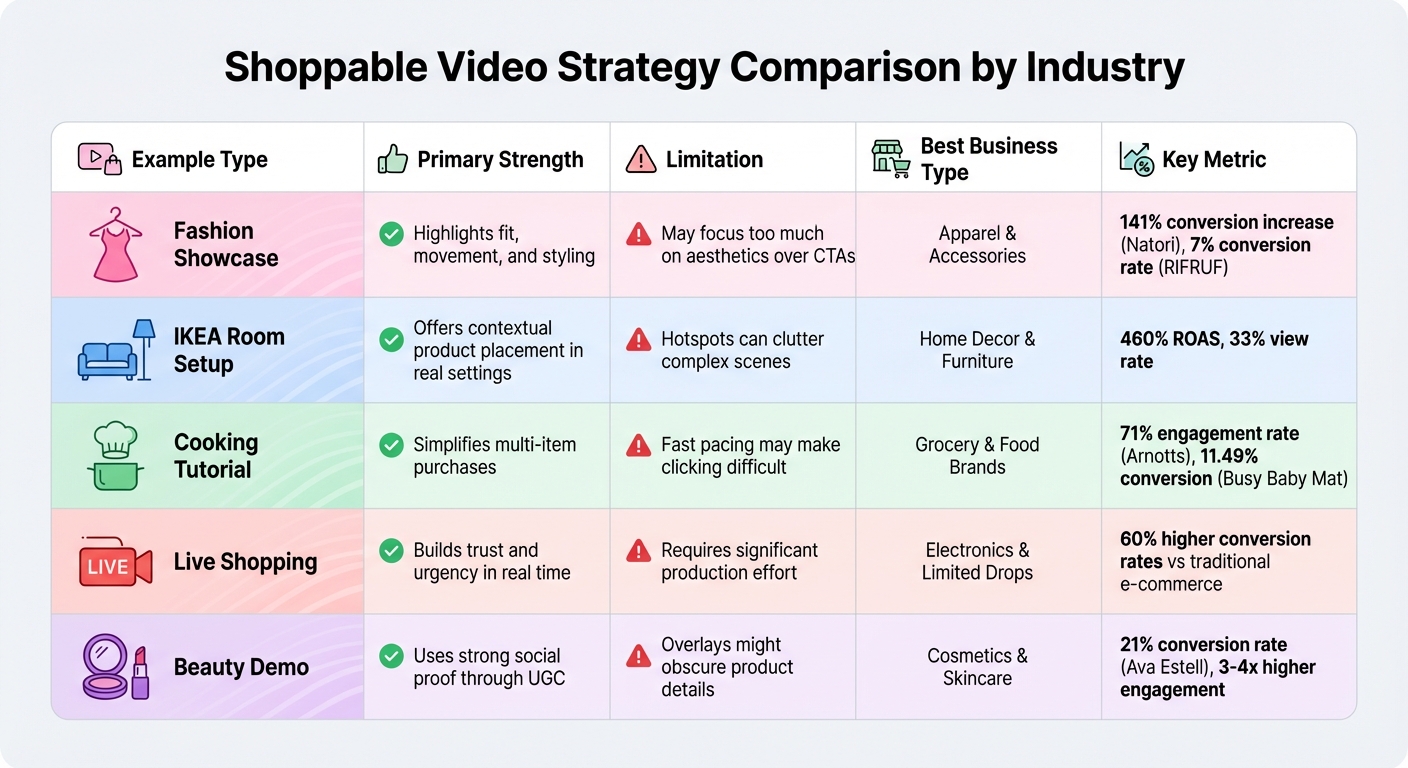
Shoppable Video Strategy Comparison by Industry: Strengths, Limitations, and Best Use Cases
Shoppable video strategies deliver mixed results depending on the industry. This highlights how important it is to tailor interactive CTAs to specific products and audiences. For example, fashion brands like RIFRUF see a 7% conversion rate with "Shop Now" buttons, as videos showcasing fit and movement outperform static images in engaging shoppers. In the home goods sector, product hotspots allow viewers to explore room setups at their own pace, encouraging a discovery-driven shopping experience. Meanwhile, cooking tutorials with "Add to Cart" tags are particularly effective for multi-item purchases. Busy Baby Mat, for instance, achieved an impressive 11.49% conversion rate by using how-to videos that clearly demonstrate product value.
Beyond these specific metrics, broader tactics like live events and discount overlays add urgency and build trust, which can drive conversions. Live shopping events, featuring real-time discounts and interactive Q&A sessions, create a sense of immediacy and foster consumer trust. In the beauty industry, "Get Discount" overlays paired with before-and-after footage have proven effective. Ava Estell reported a 21% conversion rate, showing how visual results can boost confidence in skincare products.
| Example Type | Primary Strength | Limitation | Best Business Type |
|---|---|---|---|
| Fashion Showcase | Highlights fit, movement, and styling | May focus too much on aesthetics over CTAs | Apparel & Accessories |
| IKEA Room Setup | Offers contextual product placement in real settings | Hotspots can clutter complex scenes | Home Decor & Furniture |
| Cooking Tutorial | Simplifies multi-item purchases | Fast pacing may make clicking difficult | Grocery & Food Brands |
| Live Shopping | Builds trust and urgency in real time | Requires significant production effort | Electronics & Limited Drops |
| Beauty Demo | Uses strong social proof through UGC | Overlays might obscure product details | Cosmetics & Skincare |
These comparisons show how strategy nuances align with consumer expectations in different industries. The data emphasizes that interactive content doesn’t just increase clicks - it also builds trust. Fashion and beauty brands thrive when video showcases product advantages that static images can’t, while home goods and cooking tutorials succeed by addressing practical consumer questions like, “Will this fit my space?” or “What ingredients do I need?”
To implement these insights effectively, consider tools like UWidget for seamless CTA integration on Shopify. UWidget, developed by Fractal Apps, offers YouTube widget integration starting at $5.99/month and boasts a stellar 5.0/5 rating on the Shopify App Store. Tailor your CTA design to fit your product category and align with buyer behavior.
Conclusion
The influence of shoppable videos on customer behavior is undeniable. As highlighted, well-placed and tailored calls-to-action (CTAs) can seamlessly connect product discovery to purchase. Consider this: 87% of customers report that video content impacts their buying decisions.
Timing and format play a big role in effectiveness. For example, placing your primary CTA between 21 and 34 seconds into the video aligns with peak engagement. Additionally, vertical videos hold an edge, drawing 40% more attention than other formats. Using clear and direct CTAs like "Shop Now," "Quick Add," or "Get Discount" ensures viewers can effortlessly move from interest to action.
For Shopify merchants, tools like UWidget simplify the process of embedding interactive video elements. Starting at $5.99 per month with a 5.0/5 rating on the Shopify App Store, UWidget allows you to integrate YouTube galleries, carousels, and Shorts directly into your storefront. Meanwhile, CheckIt helps sustain momentum by adding visual checkout progress indicators, increasing the likelihood of completed purchases.
Real-world results back these strategies. For instance, Ava Estell saw an additional $743,000 in revenue, while Busy Baby Mat achieved an 11.49% conversion rate by aligning video strategies with customer behaviors. Even more compelling, personalized CTAs convert 202% better than generic ones, emphasizing the importance of tailoring your approach.
To get started, choose a video format that aligns with your industry, test CTA placements within the 21–34-second range, and leverage tools that simplify integration. Bridging the gap between product discovery and purchase has never been easier.
FAQs
How do shoppable videos help boost my brand's conversion rates?
Shoppable videos have the potential to drive higher conversion rates by simplifying the shopping process and keeping viewers engaged. These videos let users buy products directly within the video itself, cutting out extra steps like visiting a separate product page. This straightforward approach encourages on-the-spot purchases and minimizes the risk of losing customers during the buying journey.
What makes shoppable videos stand out is how they blend visual storytelling with interactive elements. This combination allows brands to highlight product features in a way that grabs attention and feels relatable. By doing so, they not only hold the audience's interest but also build trust, making viewers more likely to act quickly on a purchase.
What are the key tips for creating effective CTAs in shoppable videos?
When crafting CTAs (Call-to-Actions) for shoppable videos, timing, clarity, and interactivity are key elements to consider. The best time to place a CTA is between 21–34 seconds - this is when viewers are typically most engaged and ready to take action.
Make your language direct and action-focused. Phrases like "Shop Now", "Add to Cart," or "Claim Your Discount" clearly guide viewers on what to do next. Keep it short and to the point for maximum impact.
To ensure your CTA stands out, use contrasting colors, bold fonts, and sizes that work well on mobile devices. For an even smoother shopping experience, include interactive features like clickable product tags or buttons. These elements not only grab attention but also make it easy for users to act immediately. By blending these strategies, you can create CTAs that not only look great but also drive real results.
How do shoppable videos vary across industries like fashion, home goods, and beauty?
Shoppable videos are designed to meet the specific needs of different industries, with variations in style, content, and audience engagement. For fashion brands, these videos often feature visually captivating, story-driven content that allows viewers to shop directly for items like clothing or accessories as they watch.
In the beauty industry, tutorials and product demos take center stage. These videos highlight how products like makeup or skincare perform, building trust and encouraging viewers to make a purchase.
For home goods, the focus shifts to showcasing items in real-life settings. This approach helps customers imagine how furniture or decor will look in their own homes, making the buying decision easier.
By tailoring video styles to match the audience's expectations in each industry, brands can create content that not only engages viewers but also drives conversions effectively.